

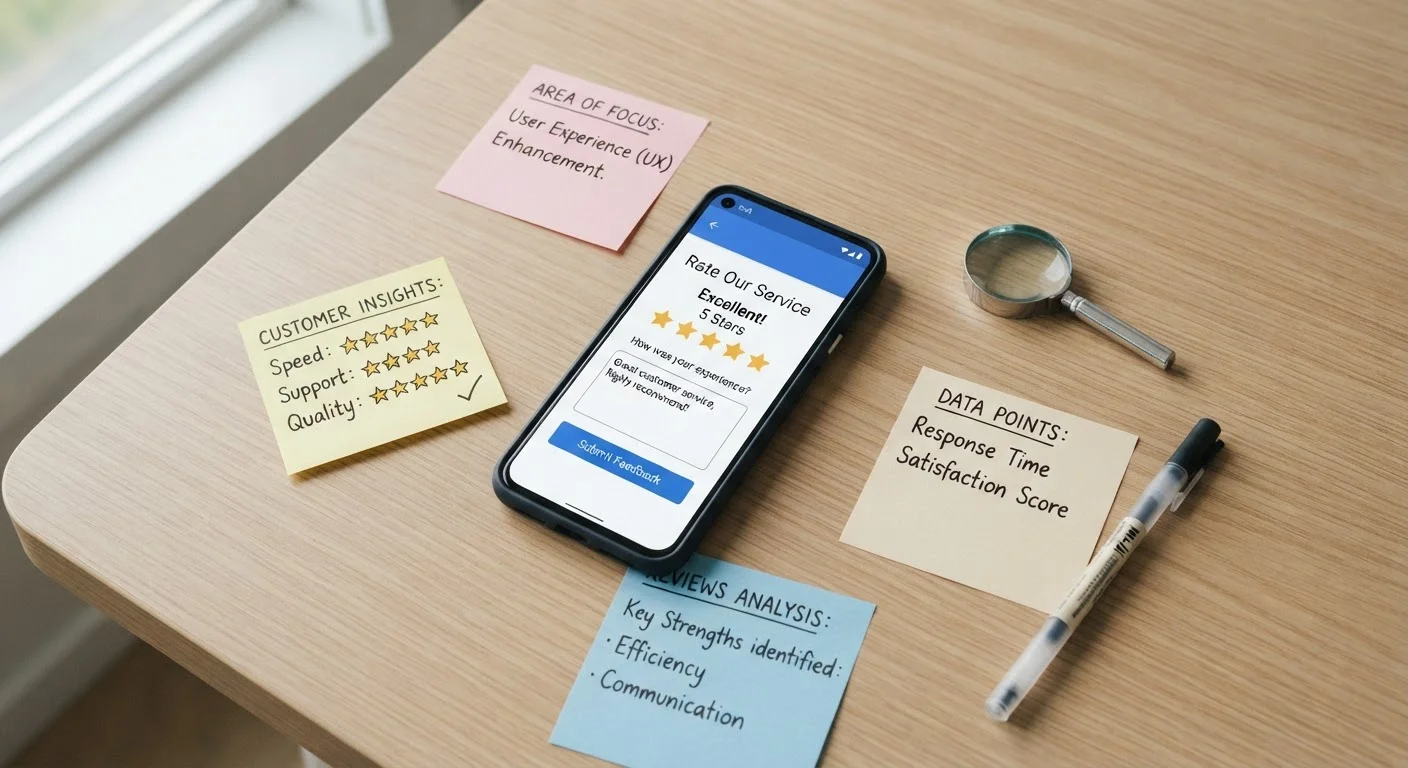
What a Star Rating Actually Captures
When you see a 4.3-star product, you're looking at a mathematical average of self-reported satisfaction — not a quality certificate. Satisfaction is personal: a reviewer who expected a budget product and got exactly that may give five stars, while an expert user with higher expectations gives two. Both ratings collapse into the same number.
Reviews also reflect the experience of people motivated enough to write them. Post-purchase surveys consistently show that very happy and very unhappy customers respond at far higher rates than people who had an ordinary, functional experience. That self-selection bias pulls averages toward extremes and makes the middle — where most real-world performance lives — underrepresented.
Platform design compounds this. Prompts to "leave a review" often appear immediately after delivery, before long-term durability or reliability has had time to reveal itself. A product that feels great on day three may look different after six months of real use.
Myth
More reviews always mean a more trustworthy score.
Fact
Volume reduces statistical noise, but it doesn't correct for systematic bias in who reviews or why.
A product with 10,000 reviews can still carry a distorted average if it was heavily promoted through post-purchase email campaigns or if a period of manufacturing changes created a cohort of dissatisfied buyers whose reviews are buried by older positive ones. Volume is a necessary but not sufficient condition for trustworthiness.
Myth
A verified purchase label confirms the review is authentic.
Fact
Verification confirms a transaction occurred — it cannot confirm the reviewer used the product, had an independent experience, or wasn't incentivized.
Incentivized review schemes — where sellers offer refunds, gift cards, or discounts in exchange for positive feedback — often involve real transactions. The purchase is verified; the independence of the opinion is not. Platforms have tightened enforcement, but the practice persists across categories. Unusually uniform language across reviews or a clustering of reviews on a single date are worth noting.
Myth
A product with a high average is objectively better than one with a lower average.
Fact
Star averages reflect satisfaction relative to expectation, not absolute performance against a standard.
Two products in different price tiers can carry similar averages while performing very differently in measurable ways. Reviewers calibrate satisfaction against what they paid and expected. A premium product rated 4.1 stars may outperform a budget product rated 4.6 stars on every objective metric — but the budget buyers' lower expectations generated higher satisfaction scores. Comparing averages across price tiers or use cases is rarely meaningful.
Myth
Negative reviews are the most useful ones to read.
Fact
Negative reviews reveal failure modes but skew toward atypical experiences and emotional responses; they require as much critical reading as positive ones.
One-star reviews frequently describe damaged shipping, customer service friction, or user error — issues unrelated to the product's core function. They're useful for identifying whether a specific failure mode matters to your situation, but treating them as representative of the average experience is a mistake. Reading a stratified sample — a handful from each star tier — gives a more complete picture than filtering to the bottom.
Myth
Review scores reflect how a product performs for most buyers.
Fact
Reviews reflect how a product performed for the subset of buyers who chose to write about it — a meaningfully different group.
Research into online review participation consistently finds that response rates are low and non-random. People who had notable experiences — strongly positive or strongly negative — are more likely to write. People who received the product, found it functional, and moved on rarely do. This means the "average" experience is often the one least represented in the review pool.
The Gaps Reviews Routinely Miss
Even a large, genuine review pool has structural blind spots. Reviewers describe their own context — their setup, habits, and expectations — which may have little overlap with yours. A mattress that earns praise from light sleepers sharing a bed tells you almost nothing about how it performs for a restless single sleeper. Use-case mismatch is one of the most consistent ways reviews mislead careful shoppers.
~82%
Shoppers who consult reviews before buying
According to multiple consumer research surveys, the vast majority of US shoppers read online reviews before making a purchase decision.
Less than 5%
Typical product review participation rate
Industry analyses suggest only a small fraction of buyers leave a review, meaning most published scores represent a non-representative minority.
Durability is another chronic gap. Most consumers don't return to update a review after a year. Products with impressive initial review scores sometimes accumulate complaints in later batches or after manufacturer changes — changes invisible to anyone reading the current star average. Looking at review date distribution, not just the total count, is one practical workaround.
Fit-and-finish complaints dominate many review pools while obscuring performance data. A kitchen appliance might collect low stars for confusing instructions while its core cooking function outperforms alternatives. Sorting by star tier and reading a sample at each level surfaces the signal more reliably than reading the top-voted reviews, which tend to be the most theatrical.
For a broader framework on approaching unfamiliar product categories before you even reach the review stage, see this guide to navigating unfamiliar purchases.
Watch for Review Clustering and Sudden Spikes
A sudden surge of five-star reviews within a short date window — especially on a new or relaunched product — can indicate a coordinated campaign rather than organic satisfaction. Platforms work to detect and remove these, but they don't catch everything. Sort reviews by most recent and check whether the tone and date distribution look natural before weighting the score heavily.
Applying the Same Critical Lens Elsewhere
The habit of reading aggregate scores critically transfers well beyond consumer products. Vehicle history reports, similarly, summarize documented events but leave gaps around unreported damage and private-party service history. And credit scores — as explained in what your credit score actually measures — compress complex financial behavior into a single number that many people misread as a complete picture of their creditworthiness.
In each case, the underlying principle is the same: a summary metric is a starting point, not a verdict. The productive questions are always: Who generated this data? What were their incentives? What situations are excluded? Asking those questions of review scores — before they anchor your judgment — is the most transferable consumer skill you can build.
This article is for informational purposes only. Purchasing decisions should be based on your individual needs, and findings here represent general patterns rather than guarantees about any specific product or category.
The content on this site is for informational purposes only and is not a substitute for professional advice. Always consult a qualified professional for guidance specific to your situation.