

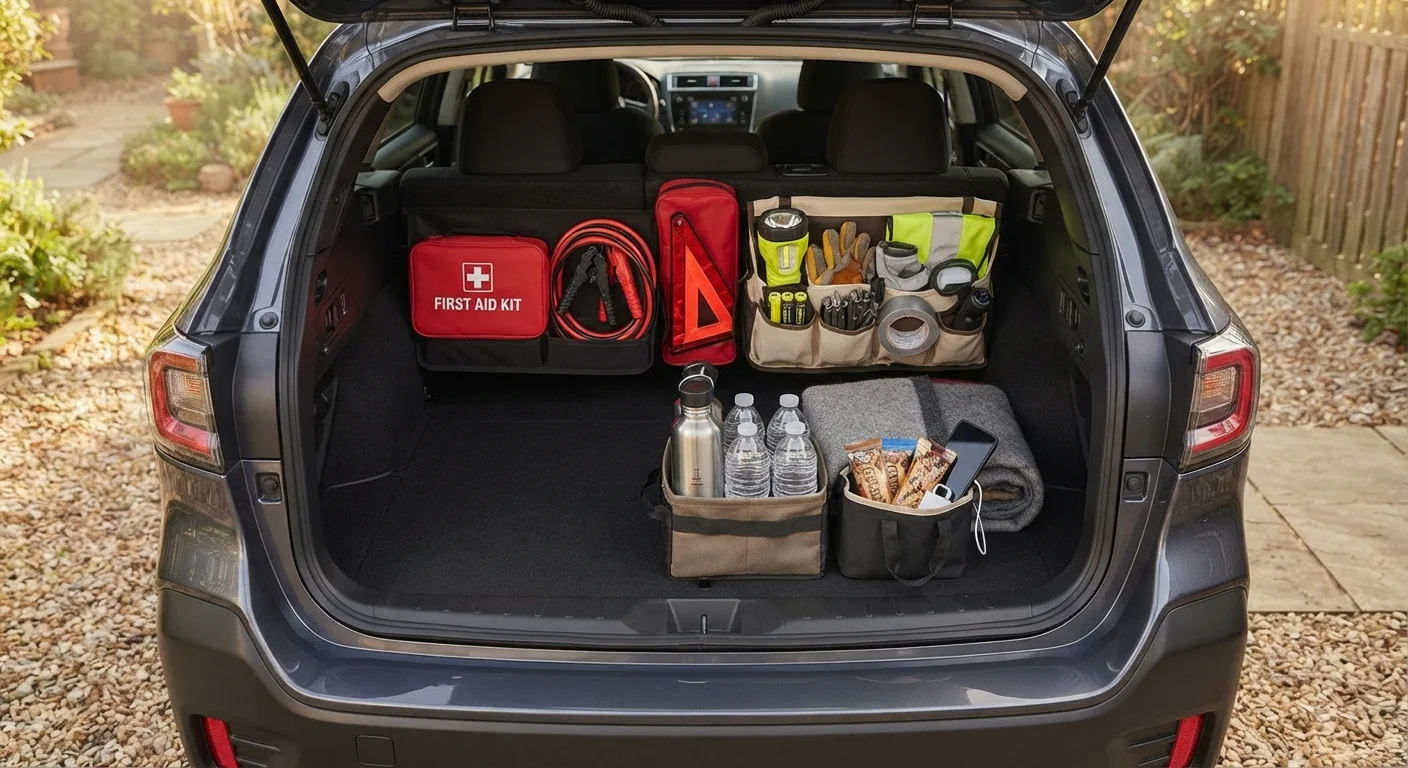
Why Your Trunk Deserves a Strategy
Most road trippers think about snacks and playlists. Far fewer think about what happens when the car won't start at a rural rest stop, or when a tire goes flat on a highway with no cell signal. The gap between being stranded and back on the road often comes down to what's already in your vehicle.
This isn't about packing for every possible disaster. It's about covering the high-probability situations with practical, compact tools you actually know how to use. For a broader look at getting your first long drive dialed in, see our practical primer for first-time long-distance road trippers.
Jumper Cables or a Portable Jump Starter
A dead battery is one of the most common roadside problems, and it's almost always fixable on the spot. Traditional jumper cables work fine if another vehicle is nearby, but a portable lithium jump starter lets you handle it solo — no stranger required. Look for one rated for your engine size and store it where it won't freeze in winter months.
If you carry cables, make sure you know the correct connection order before you need it: positive to dead, positive to good, negative to good, negative to unpainted metal on the dead vehicle.
A dead battery is almost always fixable on the spot — if you have the right equipment.
A Compact First-Aid Kit
Pre-assembled kits cover the basics: adhesive bandages, gauze, antiseptic wipes, medical tape, and over-the-counter pain relief. A good kit also includes scissors, tweezers, and gloves. Check expiration dates on medications once a year and replace anything used.
If anyone in your group has a known allergy or medical condition, supplement the standard kit accordingly — and consult with their healthcare provider about what to carry. This is general preparedness, not medical advice.
Check kit expiration dates annually — a well-stocked kit only helps if supplies are still viable.
Warning Triangles or LED Road Flares
If you're ever stopped on the shoulder of a highway, visibility is your first priority. Reflective warning triangles are compact, reusable, and don't require batteries. LED road flares are visible from farther away and work well in rain or fog — though they do require batteries or charging.
Place them at least 100 feet behind your vehicle, or more on a high-speed road. Traditional flame flares are increasingly discouraged due to fire risk near fuel and dry vegetation.
Reflective triangles are compact and reusable — place them well behind your vehicle on high-speed roads.
Tire Repair Essentials
A functional spare tire, a jack, and a lug wrench are the minimum. Know where your spare is located — often in the trunk floor or mounted underneath the vehicle — and verify it's properly inflated before a long trip, not during one.
A portable tire inflator and a can of tire sealant can handle slow leaks and minor punctures without a full swap. These won't fix sidewall damage, but they cover the majority of flat-tire scenarios and take up minimal space.
Check your spare's inflation before every long trip — a flat spare is no help at all.
Flashlight and Extra Batteries
Breakdowns don't schedule themselves around daylight. A reliable LED flashlight is essential for changing a tire at night, reading under a hood, or signaling for help. A headlamp version frees up both hands for mechanical tasks.
Keep batteries stored separately if the flashlight will sit unused for months — batteries left in a device can corrode and render it useless exactly when you need it. Recharge any rechargeable models before each trip.
Store batteries separately during long periods of non-use to prevent corrosion damage.
Water and Non-Perishable Food
At minimum, carry one gallon of water per person for a day-long trip, more for desert or remote routes. This covers hydration if you're stranded and basic cooling needs if your engine overheats. Sealed water doesn't expire quickly but should be rotated annually.
Energy bars or other shelf-stable snacks with reasonable calorie density round out the basics. This isn't about survival rations — it's about keeping energy levels stable during an unplanned multi-hour wait.
Carry at least one gallon of water per person — more on desert or remote routes.
A Basic Multi-Tool or Wrench Set
A quality multi-tool — one with pliers, a knife, screwdrivers, and a wire cutter — handles a surprising number of roadside tasks. You don't need a full mechanic's toolkit; a cluttered toolbox is harder to use under stress than a compact, purposeful set.
A pair of gloves prevents cuts and keeps your hands clean when handling mechanical components. Pair the multi-tool with a roll of duct tape and a few zip ties, which can temporarily secure loose trim, hoses, or components until you reach a shop.
A multi-tool plus duct tape handles a wide range of temporary fixes until you reach a mechanic.
Build the Kit That Fits Your Trip
The core list above covers the vast majority of real-world roadside situations. From there, tailor based on your route and season: desert driving in summer warrants extra water; mountain passes in winter call for tire chains and an ice scraper. Traveling with children adds another layer — see our guide on keeping kids comfortable across hundreds of miles for specific considerations.
Audit Your Kit Before Every Trip
Set a reminder to check your kit at the start of each road trip season — typically spring and fall. Verify that batteries are charged, medications haven't expired, and the spare tire is properly inflated. A kit that's never been checked is only slightly better than no kit at all.
One thing your kit can't replace: the paperwork that goes with it. Insurance cards, vehicle registration, and roadside assistance contact numbers belong in the glove box, not buried in a bag. Our companion piece on documents every road tripper should carry walks through exactly what to keep accessible. Emergency repairs can also hit budgets hard — factor that reality into your planning with our breakdown of hidden road trip costs most travelers don't budget for.
The content on this site is for informational purposes only and is not a substitute for professional advice. Always consult a qualified professional for guidance specific to your situation.