

What Porosity Actually Means
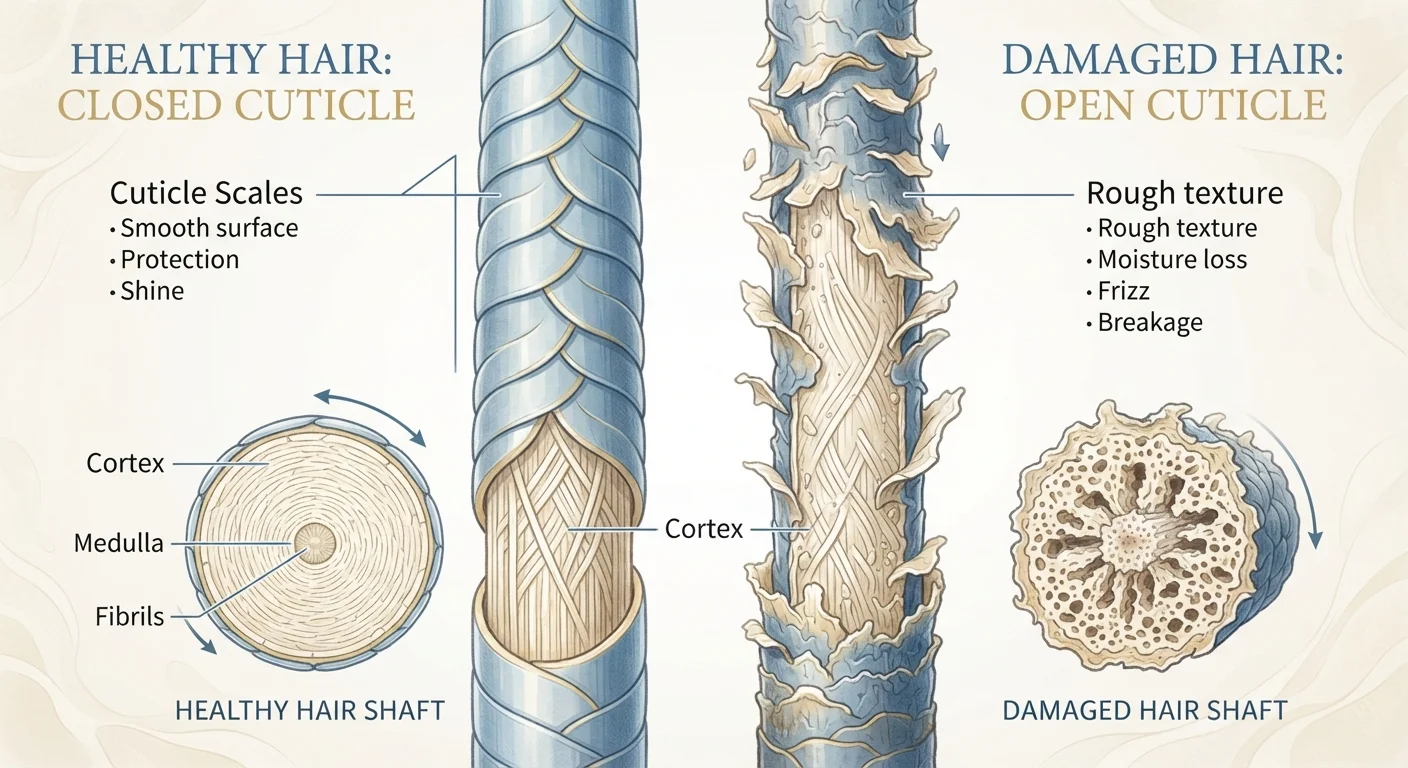
Every hair strand is wrapped in a protective outer layer called the cuticle - a series of overlapping, scale-like cells that surround the inner cortex. Think of it like roof shingles: when those scales lie flat and tight, the cuticle is relatively closed. When they're lifted or gapped, the cuticle is more open.
Porosity describes this openness and has three general categories:
- Low porosity: Cuticle scales lie flat and tightly bound, making it difficult for water or product to penetrate.
- Medium (or normal) porosity: Cuticle scales allow moisture in at a reasonable rate and retain it fairly well. This is considered the most balanced state.
- High porosity: Cuticle scales are raised, lifted, or have gaps, allowing moisture to enter easily - but also escape just as fast.
Your baseline porosity is largely genetic, but it can shift significantly depending on how you treat your hair over time.
Porosity Is a Spectrum, Not a Box
The three-category model (low, medium, high) is a useful simplification, but real hair exists on a continuum. Your hair can also have mixed porosity - for example, healthier roots with more damaged, higher-porosity ends. The categories are a starting framework, not a strict classification system.
Why Porosity Shapes Your Hair's Behavior
If you've ever wondered why a conditioner that works beautifully for someone else leaves your hair feeling heavy and coated - or why your hair feels dry within hours of washing - porosity is often the explanation.
Low porosity hair tends to repel water initially. Products sit on the surface rather than absorbing, leading to buildup. The upside is that once moisture is inside the strand, it stays there well. Warm water and lightweight, humectant-rich formulas tend to work better than heavy creams for this hair type.
High porosity hair soaks up water quickly but loses it almost as fast. Hair may feel moisturized immediately after washing, then dry and brittle within hours. Heavier emollients and occlusive ingredients can help slow that moisture loss by coating the lifted cuticle.
Understanding this dynamic explains why hair oils interact differently depending on your porosity - a light oil may penetrate low porosity hair poorly, while the same oil on high porosity hair can help seal the cuticle temporarily.
~30%
Cuticle layers on a typical hair strand
A single hair shaft can have between 6 and 10 overlapping cuticle cell layers; their integrity is the primary factor determining porosity.
Up to 45%
Reduction in hair strength after bleaching
Research published in the International Journal of Cosmetic Science has documented significant tensile strength loss in chemically bleached hair, corresponding with elevated porosity.
What Raises Hair Porosity
While genetics set your baseline, several common factors can push porosity higher over time:
- Chemical processing - bleaching, coloring, relaxing, and perming all disrupt the cuticle structure. Bleaching in particular causes significant and often permanent cuticle damage.
- Heat styling - repeated use of flat irons, curling wands, and blow dryers at high heat causes the cuticle to lift and eventually crack.
- UV exposure - prolonged sun exposure degrades the cuticle surface, which is why hair often feels drier and more porous after summer.
- Mechanical damage - aggressive brushing, towel-drying, and tight styles that cause friction all physically wear down the cuticle over time.
This is worth knowing because high porosity caused by damage behaves differently from naturally higher porosity hair. Both can benefit from similar care strategies, but understanding the root cause helps you avoid the behaviors that worsen it. Scalp health also plays an indirect role - follicle function affects the quality of hair produced at the root, even if it doesn't alter existing strand porosity.
Start With Observation, Not Tests
Rather than relying solely on the float test, observe how your hair behaves: Does water bead on the surface before soaking in? Does moisture disappear within hours? How quickly does product absorb? Behavioral clues are often more reliable than any single test and help you understand your hair's needs in real conditions.
Applying Porosity Knowledge Practically
Porosity isn't a diagnosis that requires a dramatic routine overhaul - it's a lens for making smarter choices. A few practical principles:
- For low porosity hair: Use gentle heat (a warm towel or hooded dryer) when deep conditioning to help products penetrate. Avoid heavy butters and oils that will just sit on the surface. Clarify regularly to prevent buildup.
- For high porosity hair: Focus on sealing after moisturizing - applying a light oil or butter on top of a water-based product can slow moisture loss. Cold water rinses help encourage the cuticle to lie flatter. Consider protein treatments periodically to temporarily reinforce the cuticle.
- For medium porosity hair: You have the most flexibility. Focus on consistency and avoiding unnecessary damage rather than compensating for extremes.
Porosity is also just one piece of the picture. How it interacts with your curl pattern, strand density, and overall hair type shapes what will actually work for your hair. And how you integrate all of this into your routine - frequency, order, and technique - matters just as much as ingredient selection. See our guide on building a consistent hair care habit for a practical framework.
This article is for general informational and educational purposes only. Individual hair needs vary - if you have concerns about scalp conditions or hair loss, consult a qualified dermatologist or trichologist.
Frequently Asked Questions
The most common DIY method is the float test: drop a clean, shed hair into a glass of room-temperature water and watch for a few minutes. Hair that sinks quickly is often considered high porosity; hair that floats tends to be low porosity. This test has limitations and shouldn't be treated as definitive, but it can give you a rough starting point alongside observing how your hair behaves with water and product.
Yes. Porosity is partly genetic, but it can shift due to chemical treatments (coloring, relaxing, perming), heat styling, UV exposure, and physical damage. Repeated processing tends to raise porosity. Some damage-related porosity changes are reversible with consistent moisture care; structural damage from bleaching or breakage is generally permanent.
Porosity can influence how quickly products build up and how long moisture lasts, which may affect your ideal wash frequency. Low porosity hair is more prone to product buildup, so lighter, less frequent conditioning may work better. High porosity hair may benefit from more frequent moisturizing treatments. See our guide on <a href="/beauty-basics/routines/hair-care-as-a-daily-habit-frequency-order-and-technique">building a hair care routine</a> for practical guidance.
Not necessarily. Some people naturally have higher porosity hair, particularly those with tightly coiled curl patterns where the cuticle structure is inherently more open at the bends of each curl. That said, damage from heat or chemicals can also raise porosity, so context matters. Observing how your hair behaves overall gives a more complete picture than porosity alone.
High porosity hair generally benefits from heavier emollients and occlusive ingredients - such as butters and heavier oils - that help seal the cuticle and slow moisture loss. Protein treatments can also temporarily fill gaps in the cuticle. Our article on <a href="/beauty-basics/haircare/protein-treatments-and-moisture-balance-in-hair">protein treatments and moisture balance</a> covers this in more detail.
Porosity and curl pattern are separate properties, though they can interact. A person with fine, straight hair can have high porosity just as someone with coily hair can have low porosity. Our article on <a href="/beauty-basics/haircare/what-your-hair-type-actually-means-and-why-it-matters-for-your-routine">what hair type actually means</a> explains how these properties fit together.
The content on this site is for informational purposes only and is not a substitute for professional advice. Always consult a qualified professional for guidance specific to your situation.