

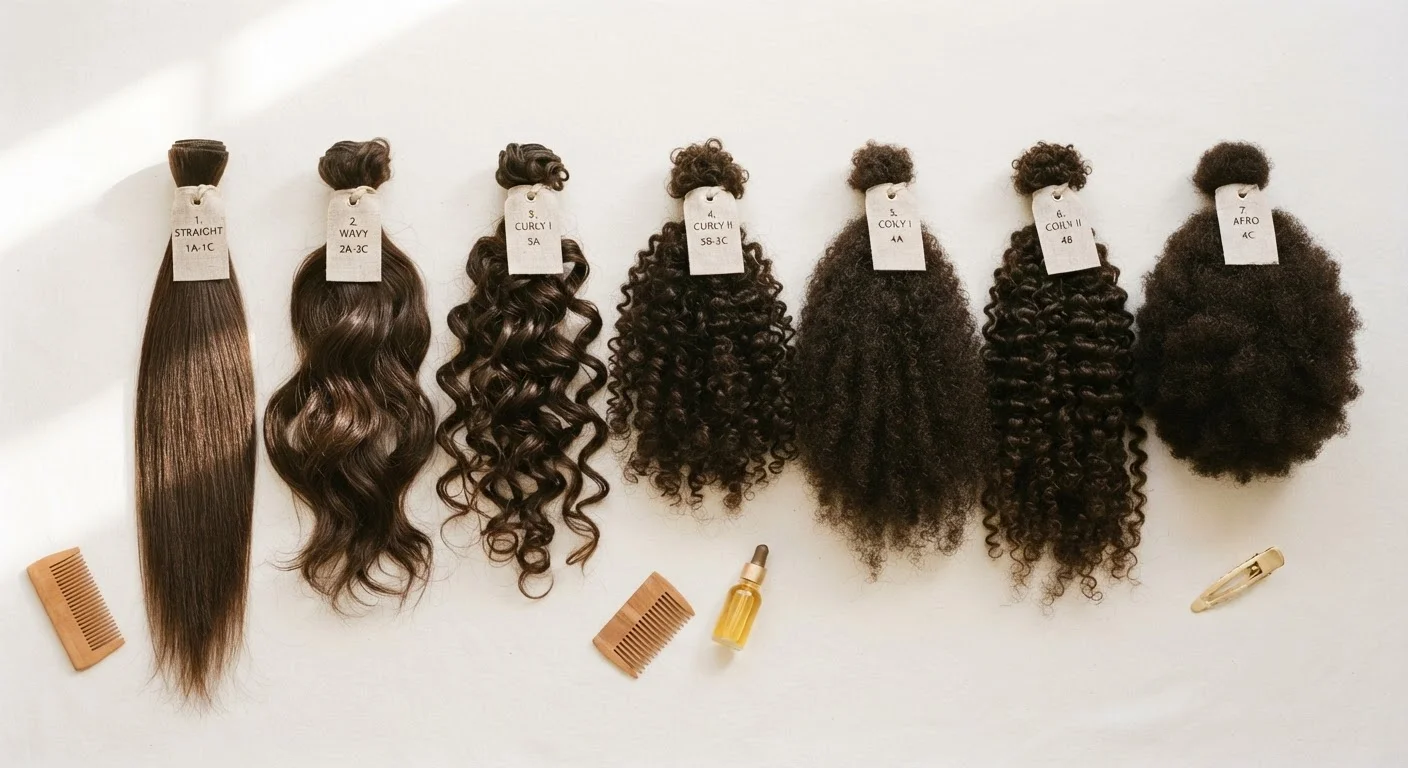
Why Hair Typing Exists - and What It Was Designed to Do
The language of hair types - 2C, 4B, fine, coarse - is everywhere in haircare marketing. But most popular typing systems weren't built in a laboratory. The most widely used classification, the 1-4 curl scale, originated as a commercial framework. Its goal was to match consumers to product lines, not to give a clinically precise picture of hair biology.
That doesn't make it useless. As a shared vocabulary for describing curl pattern, it's genuinely helpful - particularly for people navigating texture-specific communities or tutorials. The problem comes when it's treated as a complete guide to hair care, because curl shape is only one variable among several that determine how your hair behaves.
Hair Typing Systems Vary Across Communities
Different haircare communities use different classification systems, and some include additional variables like porosity or elasticity alongside curl pattern. There is no single universal standard. When reading tutorials or community advice, note which system is being used and what it does - and doesn't - account for.
Understanding what these systems do and don't capture is the first step toward using them wisely rather than being misled by them.
The Four Properties That Actually Shape Your Hair's Needs
A genuinely useful hair profile accounts for at least four characteristics:
- Curl pattern - the shape of the hair strand, from straight to coily. This affects styling approach, drying time, and frizz behavior.
- Porosity - how well the hair cuticle absorbs and retains moisture. High-porosity hair soaks up product quickly but loses moisture just as fast; low-porosity hair resists absorption but holds moisture well once it's in. This property is often the most actionable guide for choosing product formulas. See our full breakdown: hair porosity explained.
- Density - how many individual strands sit on the scalp. High-density hair can handle heavier products; low-density hair is easily weighed down.
- Strand width - fine strands are more fragile and prone to breakage from heavy products; coarse strands are structurally stronger but may resist penetration from lighter formulas.
Most people have a mix - for example, coily curl pattern with low porosity and fine strands. That combination responds very differently to products than coily hair with high porosity and coarse strands, even though both would carry the same curl-type label.
4
Key properties that define hair behavior
Curl pattern, porosity, density, and strand width together create a more complete picture than curl pattern alone.
1-4
Curl classification scale widely used in haircare
The Andre Walker system describes curl shape only; it was originally developed as a commercial product-matching tool, not a clinical assessment.
Reading Past the Marketing on Haircare Labels
Once you understand your hair's actual properties, you're better equipped to evaluate the claims on product packaging. Terms like "moisturizing," "strengthening," and "repair" have no standardized regulatory definition in the US - they describe a desired effect, not a guaranteed outcome.
What matters more is the ingredient list and product texture. A dense, butter-rich cream is typically suited to high-porosity, coarse, or very dry hair. A lightweight liquid or mousse is better matched to fine or low-porosity hair that absorbs slowly. For a practical guide to what label language does and doesn't signal, see decoding a haircare label.
Test Products on a Small Section First
Before committing a new formula to your full head of hair, apply it to a small section and assess how it feels after drying. Look for signs of buildup, dryness, or frizz. This is especially useful when you're uncertain whether a product weight matches your porosity and density.
It's also worth remembering that scalp health underlies everything. Product choice for your strands is only part of the equation - the environment where hair grows matters just as much. Our article on scalp health and hair quality explains this connection in detail.
Hair Type Is a Starting Point, Not a Prescription
Your hair's characteristics can shift meaningfully across your lifetime. Hormonal changes, nutritional status, heat and chemical processing, and even seasonal humidity affect texture and porosity. What worked at 25 may need adjusting at 40, and what works in a humid climate may fall flat in a dry one.
Hair changes can also reflect something happening internally. Nutritional deficiencies can show up in your hair - changes in thickness, shedding rate, or texture are sometimes worth discussing with a healthcare provider rather than simply adjusting your product lineup.
The goal of understanding your hair type is to give you a framework for making informed choices - not a fixed identity to optimize around. Build your routine around what your hair actually does, observe how it responds to changes, and adjust accordingly. For a practical starting structure, building a workable hair routine offers a grounded breakdown of frequency, order, and technique.
This article is for general informational purposes only and does not constitute medical or professional haircare advice. If you are experiencing significant hair loss, scalp changes, or other concerns, consult a qualified healthcare professional.
Frequently Asked Questions
The 1-4 system categorizes hair from straight (1) to tightly coiled (4), with A-C subcategories indicating curl tightness. It was popularized by stylist Andre Walker and is useful as a visual reference, but it only describes curl pattern - not porosity, density, or strand width, which often matter more for product choices.
Porosity describes how readily your hair absorbs and holds moisture. A simple at-home indicator is dropping a clean strand into water - high-porosity hair tends to sink quickly, while low-porosity hair floats. For a more reliable read, our guide on <a href="/beauty-basics/haircare/hair-porosity-the-property-most-people-have-never-heard-of">hair porosity</a> walks through what each level means in practice.
Yes. Hormonal shifts, pregnancy, aging, nutritional changes, and chemical or heat damage can all alter texture, density, and porosity. Hair typing is best treated as a current snapshot rather than a permanent label.
Hair type narrows the field but doesn't dictate specific products. Porosity and density tend to be stronger guides for choosing product weight and formula. A lightweight serum that suits fine low-porosity hair can weigh down the same curl pattern if the hair is high porosity and needs richer moisture.
Co-washing - cleansing with conditioner instead of shampoo - is most commonly recommended for curly and coily textures because they tend toward dryness. However, anyone with very dry or fragile hair may find benefit. Our article on <a href="/beauty-basics/haircare/washing-curly-hair-why-standard-advice-often-falls-short">washing curly hair</a> covers why technique matters as much as product choice.
Because curl pattern alone is an incomplete guide. Two people with the same curl type can have very different porosity, density, and scalp conditions - each responding differently to the same formula. Understanding your full hair profile, not just your curl number, leads to better product decisions.
The content on this site is for informational purposes only and is not a substitute for professional advice. Always consult a qualified professional for guidance specific to your situation.