

Where Hair Growth Actually Happens
Hair growth is a biological process that begins entirely beneath the skin. Each strand originates inside a follicle - a small pocket in the scalp - where specialized cells in the follicle's bulb divide rapidly and push new hair upward. By the time a hair strand is long enough to see or touch, those cells are already dead, keratinized structures. They have no capacity to respond to what happens at the tip.
This is the core fact that dismantles the trimming-for-growth claim: the end of a hair strand and the follicle producing it share no biological communication. Cutting one centimeter off the bottom does not signal the root to work harder, produce faster, or extend the growth phase. Scalp follicles operate on their own genetically determined cycle - anagen (growth), catagen (transition), and telogen (rest) - and scissors have no influence over it.
For a deeper look at how the scalp environment shapes what your follicles can do, see our article on scalp health and hair quality.
~0.5 in/mo
Average human hair growth rate
Dermatology references consistently cite roughly half an inch (about 1.25 cm) per month as the average adult scalp hair growth rate, with individual variation based on genetics and health.
2-6 years
Typical anagen (active growth) phase duration
The length of time a hair spends in its active growth phase - not trimming frequency - is the primary determinant of how long your hair can ultimately grow.
What Trimming Actually Does - and Why It Still Matters
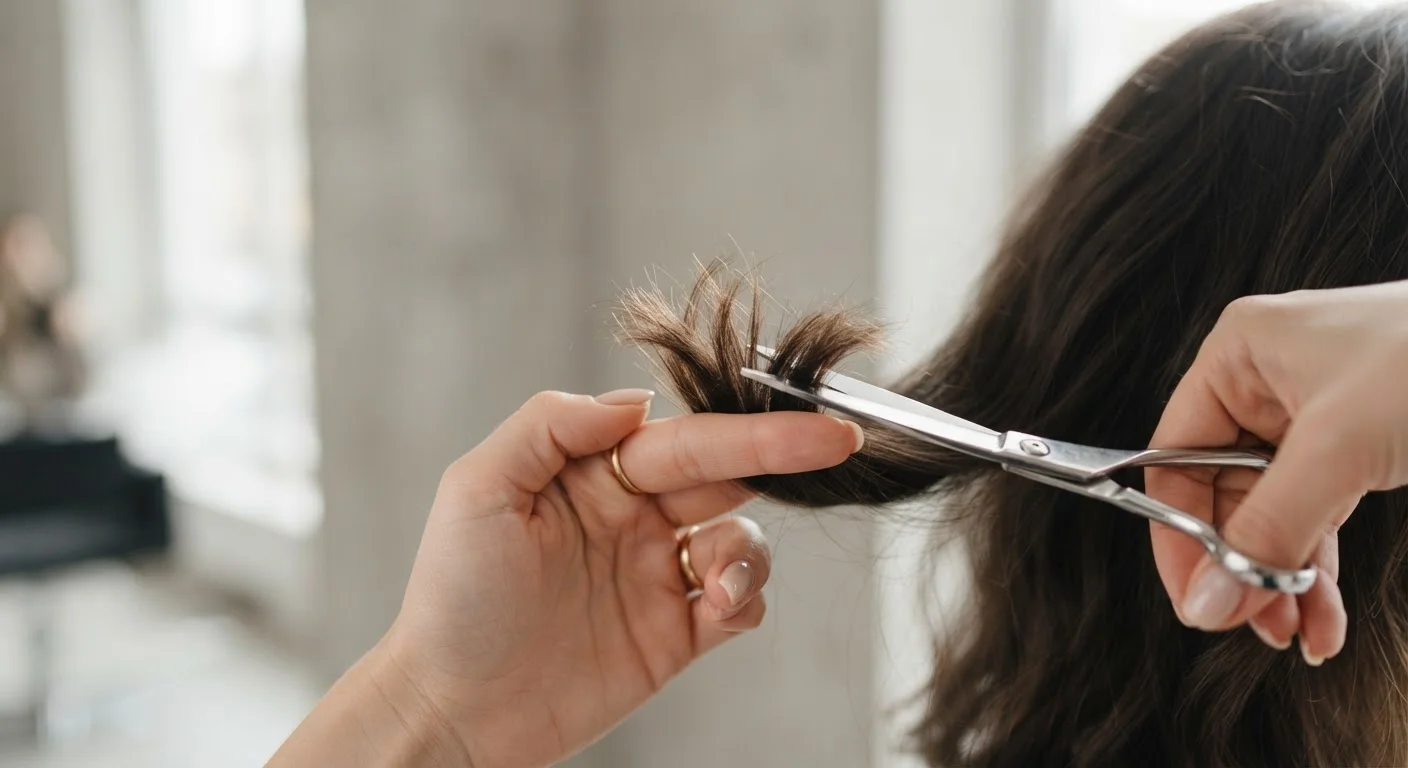
Regular trims are genuinely useful, just for a different reason than growth acceleration. When a hair strand splits at the end, that split doesn't stay put. Friction, heat, and tension cause it to travel progressively up the shaft, eventually breaking the hair at a point much higher than where it started. This breakage is what creates the illusion that hair isn't growing - it is, but it's snapping off nearly as fast.
Trimming removes the compromised portion before that upward migration occurs. By cutting off the split, you preserve the structural integrity of the rest of the strand, allowing the length your follicles have already produced to stay on your head longer. The result feels like faster growth, but what's actually happening is better length retention.
How often you need a trim depends on your hair's texture, how much heat or chemical processing it undergoes, and your daily handling habits. There is no universal schedule that applies to everyone. Small daily habits - like rough towel drying or tight elastics - quietly accelerate the kind of damage that makes more frequent trimming necessary.
Myth
Trimming your hair makes it grow faster.
Fact
Hair growth rate is controlled by follicles in the scalp. Cutting the ends has no effect on follicle activity or growth speed.
Average human hair grows roughly half an inch per month - a rate determined by genetics and overall health, not by how often you visit a salon. The tip of a strand is dead tissue; it cannot send growth signals to the living follicle. What trimming does do is remove damage before it causes breakage higher up the shaft, which protects your existing length.
Myth
Brushing your hair 100 strokes a day stimulates growth.
Fact
Excessive brushing causes friction and mechanical damage. Moderate brushing can distribute scalp oils, but it does not meaningfully stimulate follicle activity.
This belief dates to an era before modern trichology (the study of hair and scalp health). While gentle scalp massage has some evidence linking it to increased hair thickness in small studies, it's the massage - not the brush strokes - doing the work. Over-brushing, especially on fragile or dry hair, increases breakage and split ends rather than promoting growth.
Myth
Topical serums and oils can repair split ends permanently.
Fact
No product can re-fuse a split end. Some ingredients temporarily smooth the appearance of damage, but the structural break remains.
Products containing silicones or certain conditioning agents can coat the hair shaft and make split ends lie flat temporarily, which improves appearance and reduces further snagging. This is a meaningful cosmetic benefit - but it is not repair. The only way to remove a split end is to cut it. Products that claim to "repair" splits should be understood as managing the appearance of damage, not reversing it.
Myth
Washing your hair frequently stunts growth.
Fact
Regular washing does not affect follicle function or growth rate. Product buildup or scalp inflammation from poor hygiene is more likely to cause problems.
Shampoo cleans the scalp surface and the hair shaft - it does not penetrate to the follicle level or disrupt the growth cycle. Wash frequency should be based on your scalp's oil production, activity level, and hair type. Under-washing can lead to buildup that may contribute to scalp irritation over time, which is more likely to negatively affect the follicle environment than regular cleansing would.
What Actually Supports Healthy Hair Growth
If trimming isn't the growth lever, what is? The honest answer is: mostly biology, with some meaningful lifestyle inputs at the margins.
- Scalp condition: A clean, well-circulated scalp with unblocked follicles creates the best environment for hair to grow unimpeded. Chronic scalp inflammation or buildup can interfere with normal follicle cycling.
- Nutrition: Hair follicles are metabolically active and nutrient-dependent. Deficiencies in iron, zinc, biotin, and protein are associated in clinical literature with increased shedding and reduced growth rate. Addressing a real deficiency - ideally identified through a healthcare provider - can make a visible difference.
- Minimizing mechanical damage: Breakage from heat tools, aggressive detangling, and tight styles reduces the length you retain regardless of how fast your follicles work.
- Stress and health factors: Significant physical or emotional stress can push follicles prematurely into the resting (telogen) phase, resulting in increased shedding weeks later. This is a recognized clinical phenomenon, not folklore.
If you're building your routine from the ground up, our practical haircare starter guide covers washing, conditioning, and care essentials without the overwhelm.
Sudden or Excessive Shedding Warrants Medical Attention
If you notice a rapid increase in hair shedding or significant thinning, this is worth discussing with a healthcare provider - not addressing with more frequent trims or topical products. Increased shedding can be a sign of underlying conditions including thyroid dysfunction, nutritional deficiency, or hormonal changes. This article provides general educational information and is not a substitute for professional medical evaluation.
The content on this site is for informational purposes only and is not a substitute for professional advice. Always consult a qualified professional for guidance specific to your situation.