

Start here
What Healthy Hair Actually Needs
Core skills
The Core Routine: Wash, Condition, and Protect
Shop smarter
Choosing Products Without the Overwhelm
Daily practice
Daily Habits That Support or Sabotage Your Hair
Make it last
Building a Routine That Actually Sticks
What Healthy Hair Actually Needs
Hair is composed of a protein called keratin, arranged in a structure with an outer cuticle layer protecting a fibrous inner cortex. The cuticle's condition - whether its scales lie flat or are lifted and damaged - determines most of what you see and feel: shine, frizz, softness, and strength. Understanding this basic structure cuts through a lot of marketing noise.
Hair itself is not alive from the strand outward - only the follicle beneath the scalp is. This means no product can truly "repair" damage in the way the word implies. What haircare products genuinely do is clean the scalp, smooth the cuticle temporarily, reduce friction between strands, and provide a hospitable environment at the scalp for healthy new growth.
Cuticle
The outermost layer of a hair strand, made of overlapping scale-like cells. When these scales lie flat, hair appears smooth and shiny; when they're lifted or damaged, hair feels rough and looks dull.
Porosity
How easily your hair absorbs and retains moisture. Low-porosity hair resists water; high-porosity hair soaks it up quickly but also loses it fast.
Sebum
The natural oil produced by glands in your scalp. It helps protect the scalp and lubricates the hair closest to the roots, but can build up and create greasiness if not cleansed regularly.
Keratin
The structural protein that hair strands are primarily made of. It determines much of hair's strength and elasticity.
Product buildup
The accumulation of styling products, conditioner residue, or minerals on the hair shaft and scalp over time. Buildup can make hair feel heavy, dull, or difficult to style.
Mechanical damage
Physical harm to the hair strand caused by friction, tension, or rough handling - such as aggressive towel drying, tight elastics, or brushing wet hair incorrectly.
The scalp is living skin and deserves care accordingly: it benefits from regular cleansing to remove sebum, product buildup, and environmental debris. When the scalp is healthy, hair tends to grow in with better condition from the start. For readers also working on their skin routines, the foundational logic is similar - see building a skincare routine from nothing for a parallel starting point.
The Core Routine: Wash, Condition, and Protect
A functional haircare routine has three parts. Everything else is optional.
Step 1: Cleanse the Scalp
Apply shampoo primarily to the scalp, not the lengths. Work it in with fingertip (not fingernail) pressure, then allow rinse water to carry it through the ends - that's sufficient cleansing for most hair. Piling hair on top of the head and scrubbing creates tangles and friction damage.
Step 2: Condition the Lengths and Ends
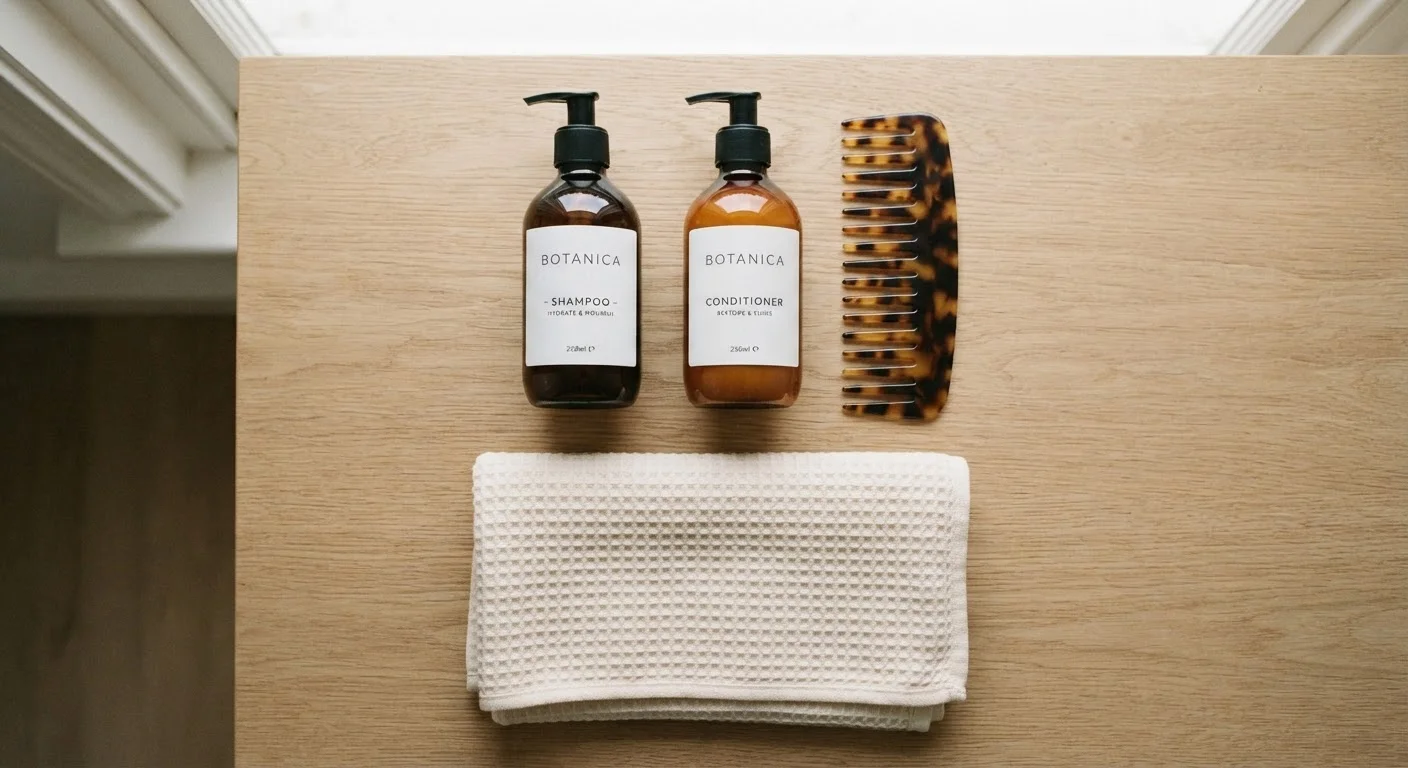
Conditioner does its work on the mid-lengths to ends, where natural scalp oils don't reach and where most damage accumulates. Apply it after rinsing shampoo, leave it for one to two minutes, and rinse thoroughly. Applying conditioner directly to the scalp can cause buildup and may contribute to greasiness.
Step 3: Handle Wet Hair Gently
Wet hair is significantly more elastic and vulnerable to mechanical stress than dry hair. Blot - don't rub - with a soft towel or microfiber cloth. Detangle starting from ends and working upward, using a wide-tooth comb. This sequence alone eliminates a large share of routine-caused breakage. For more on how these steps fit into a daily rhythm, see hair care as a daily habit.
The Detangling Order Makes a Difference
Always detangle starting at the ends of your hair and work upward toward the roots. This prevents you from dragging knots through the full length of the strand, which is where most snapping occurs. A wide-tooth comb on damp (not soaking wet) hair gives you the most control with the least damage.
Choosing Products Without the Overwhelm
The haircare aisle is engineered to create complexity. Terms like "bond-building," "strengthening," and "nourishing" describe marketing positioning more reliably than they describe measurable outcomes for your hair. The functional questions to ask are simpler:
- Is this shampoo gentle enough for my scalp? A formula that doesn't strip or irritate is the baseline. Fragrance-heavy formulas can be sensitizing for some scalps.
- Does the conditioner make detangling easier? That's the primary functional test. Slippage during combing indicates it's working.
- Am I adding a product because my hair needs it, or because marketing suggested I should?
Most beginners are better served starting with the minimum - one shampoo, one conditioner - and observing their hair's behavior over four to six weeks before adding anything else. Layering multiple products before you've established a baseline makes it impossible to know what's helping and what isn't.
What 'Clarifying' Means in Practice
Clarifying shampoos are stronger-cleansing formulas designed to remove buildup that regular shampoos leave behind. They're not meant for every wash - used too frequently, they can over-strip the scalp. Most people need a clarifying wash once or twice a month at most. Learn when a clarifying shampoo belongs in your routine and when it doesn't.
If you have curly or coily hair, the cleansing and conditioning logic shifts meaningfully. Washing curly hair explains why standard recommendations often don't apply and what does.
Daily Habits That Support or Sabotage Your Hair
Product quality matters far less than most people assume. How you treat your hair mechanically - every single day - determines far more of its long-term condition.
- Elastic bands with metal clasps create snag points that break strands over time. Fabric-covered or spiral elastics cause less damage.
- Tight hairstyles worn daily put sustained tension on the follicle, which can contribute to traction-related shedding in the hairline over time.
- Sleeping on rough pillowcases creates friction that roughens the cuticle. Satin or silk pillowcases reduce this.
- Brushing dry, tangle-prone hair from root to tip concentrates stress at knots and snaps strands. Starting at ends and working up is less damaging.
These are not minor details - habits that quietly cause breakage explores how consistently small choices compound into noticeable damage over months.
Building a Routine That Actually Sticks
Consistency matters more than complexity. A simple routine followed reliably produces better results than an elaborate one followed sporadically. Before you build out further, a few principles help:
- Set a realistic wash frequency. Most scalp types do well with two to three washes per week. Adjust based on your activity level, scalp oiliness, and hair texture - not what you've always done or what a label suggests.
- Give any change at least four weeks. Hair behaves differently in transition periods. A new product or frequency adjustment needs time before you can evaluate it fairly.
- Troubleshoot before you buy. Dryness, frizz, and greasiness often have technique causes, not product causes. Adjust your method before reaching for something new.
If you're building broader daily habits alongside this, the same slow, consistent approach applies across routines - routine-building from zero offers a practical framework for anyone starting with no established habits at all.
Hair that's already chemically processed, color-treated, or has significant existing damage may benefit from more tailored guidance. If you're uncertain whether your current routine is helping or not, before you change your entire haircare routine can help you assess what's actually working before making changes.
Frequently Asked Questions
Most people do well washing every two to four days, depending on scalp oiliness and activity level. Overwashing can strip natural oils and trigger more oil production, not less. Start with every other day and adjust based on how your scalp responds over two to three weeks.
For most hair types, yes - they serve different functions. Shampoo cleans the scalp; conditioner replenishes moisture and reduces friction along the hair shaft. Some people with very low-porosity or fine hair may use conditioner sparingly, but skipping it entirely often leads to more tangles and breakage.
Porosity describes how readily your hair absorbs and retains moisture, determined largely by the condition of the outer cuticle layer. Low-porosity hair resists moisture absorption; high-porosity hair absorbs it quickly but loses it just as fast. Understanding your porosity helps you choose conditioning approaches that actually work for your hair's structure.
Not necessarily. Research suggests that leaving hair wet for extended periods can cause the inner cortex to swell repeatedly, potentially weakening it over time. Using a blow dryer on a low-heat setting with some distance from the hair is considered by some dermatologists to be less damaging than prolonged air drying. Rough towel drying, however, is universally more damaging than either.
Yes. Price does not reliably predict product performance. A gentle, fragrance-light shampoo and a basic rinse-out conditioner are sufficient starting points. Assess how your hair responds before adding any additional products - most healthy hair needs very little beyond the basics.
If you notice sudden or significant shedding, persistent scalp irritation, flaking that does not respond to gentle cleansing, or patchy hair loss, consult a dermatologist rather than troubleshooting with products alone. These can indicate underlying scalp or health conditions that warrant professional evaluation.
The content on this site is for informational purposes only and is not a substitute for professional advice. Always consult a qualified professional for guidance specific to your situation.