

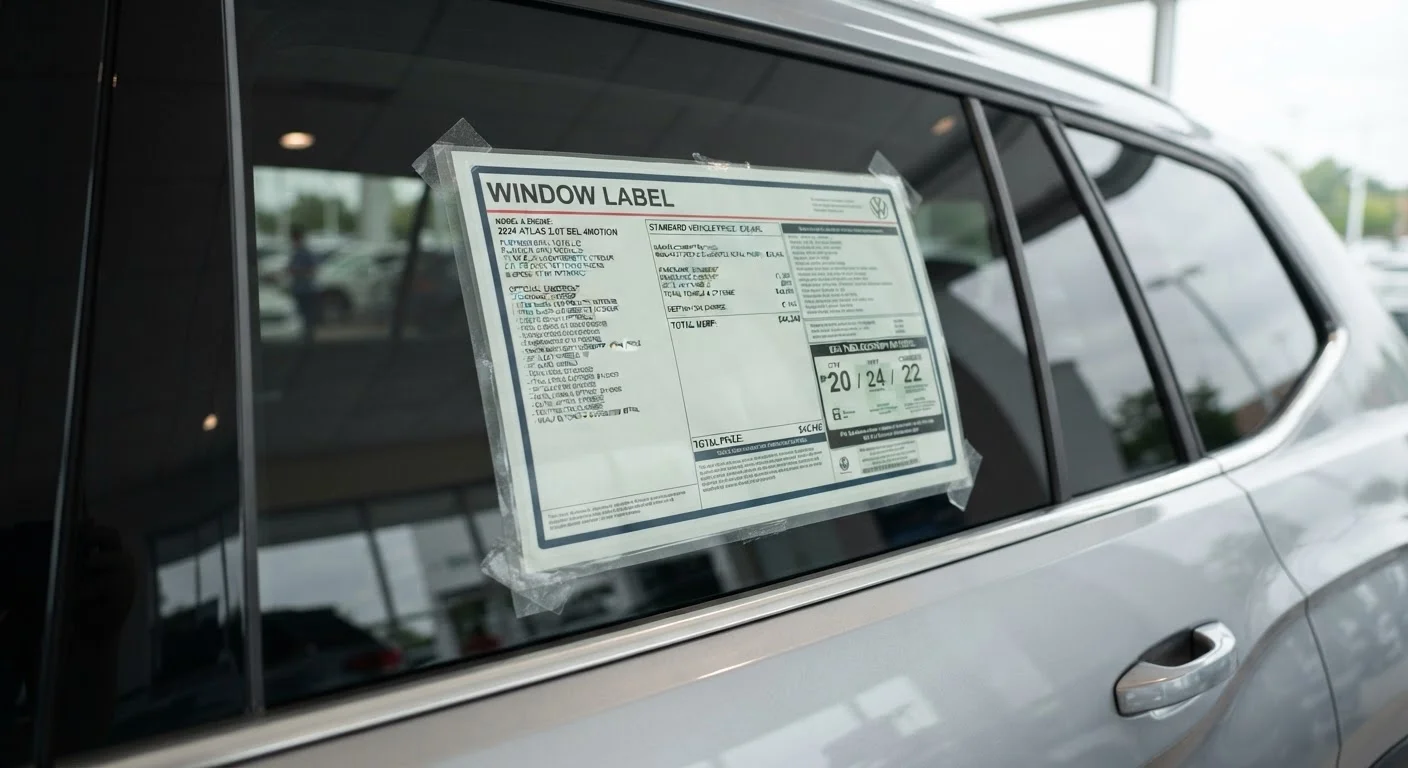
What Is a Monroney Label and Why Does It Exist?
The Monroney label — named after Senator Mike Monroney, who championed the legislation — is the window sticker federally required on every new passenger vehicle sold in the United States under the Automobile Information Disclosure Act of 1958. Its purpose is consumer protection: it standardizes the information manufacturers must disclose so buyers can make meaningful comparisons across vehicles.
The label covers the vehicle's base price, factory-installed options and their individual costs, fuel economy estimates from EPA testing, and safety ratings where available. Understanding how to read it fluently gives you a significant advantage at the dealership — and helps you avoid paying for things you neither requested nor need.
Never Remove or Cover the Monroney Label
Federal law — specifically the Automobile Information Disclosure Act — prohibits anyone other than the purchaser from removing the Monroney sticker before the vehicle is sold. If a dealer has removed it, that is a red flag. You are entitled to see the complete, unaltered label before agreeing to any purchase.
If you regularly review other types of technical documents, the approach here is similar. Our guide to reading a spec sheet covers how to interpret manufacturer technical data alongside the sticker information.
Vehicle Identification Number (VIN)
Use the VIN printed on the sticker to pull the vehicle's history report and verify the information shown matches official records.
EPA Fuel Economy Guide (fueleconomy.gov)
Cross-reference the sticker's fuel economy ratings with EPA's official database to understand how the vehicle compares to similar models.
Smartphone or tablet
Photograph the full sticker for later reference and comparison shopping without relying on memory.
How to Work Through the Sticker Step by Step
The sections below walk you through every part of the label in the order it typically appears. Follow these steps the next time you are standing at a dealership window — or reviewing a digital copy from home.
What you will need
Locate and photograph the sticker
The Monroney label is affixed to a side window — typically the rear passenger window — of every new vehicle. Before diving into its contents, take a clear photo of the entire label with your phone. This lets you review and compare figures later without returning to the lot.
Identify the vehicle and trim information
At the top of the sticker you will find the make, model, model year, trim level, and body style. Confirm these match the vehicle you are actually looking at. Trim level determines which features are standard — a higher trim on the same model can add thousands of dollars in content.
Review the standard and optional equipment lists
The sticker itemizes standard equipment (features included in the base price for that trim) and separately lists any factory-installed packages or individual options that have been added. Each option shows its individual price. Add these together with the base MSRP to check the math before proceeding.
Read the fuel economy section
The EPA fuel economy estimates appear prominently, usually in a large-font box. City, highway, and combined MPG (or MPGe for electrics) are shown. The sticker also provides an estimated annual fuel cost based on assumed average mileage and a national average fuel price — note that this figure is illustrative, not a guarantee.
Check the safety ratings section
Many Monroney labels include a safety ratings section referencing NHTSA (National Highway Traffic Safety Administration) crash test results and, where applicable, IIHS (Insurance Institute for Highway Safety) ratings. A blank or missing ratings section often means the vehicle had not been tested at the time of printing — you can look up current ratings independently on nhtsa.gov.
Examine dealer-installed accessories separately
Below the factory content, many stickers include a second section for dealer-installed accessories with their own pricing. This section is added by the dealership, not the manufacturer, and the items listed here are often negotiable. Scrutinize this section closely. [warning_callout]
Note the total MSRP and use it as your baseline
The bottom of the sticker shows the total Manufacturer's Suggested Retail Price, including all factory options. This is your negotiation baseline — not a non-negotiable number. For a fuller picture of what you will actually pay beyond this figure, see what the sticker price doesn't tell you.
Compare the EPA Estimate to Real-World Data
The EPA fuel economy figures on the sticker are a useful benchmark, but real-world mileage varies based on driving habits, terrain, and climate. Cross-referencing the sticker figures with owner-reported data from publicly available resources can give you a more realistic picture of day-to-day fuel costs.
Once you understand what the sticker tells you, it is equally useful to know what it does not tell you. Destination charges, documentation fees, and dealer profit margins are not disclosed on the Monroney. For a detailed look at those costs, see what the sticker price doesn't tell you. And if you later need to interpret paperwork after purchase, our walkthrough on reading a mechanic's service report applies the same plain-language approach to workshop invoices.
The content on this site is for informational purposes only and is not a substitute for professional advice. Always consult a qualified professional for guidance specific to your situation.