

Road Sign Categories at a Glance
U.S. road signs follow a standardized shape-and-color system defined by the MUTCD, a federal standard adopted by all 50 states. Knowing the system lets you decode an unfamiliar sign before you can read the words.
| Federal sign standard | MUTCD (Manual on Uniform Traffic Control Devices) (Federal Highway Administration) |
| Regulatory sign colors | White background, red or black lettering |
| Warning sign shape/color | Yellow diamond (MUTCD standard) |
| Work-zone sign color | Orange background |
| Yellow centerline meaning | Separates opposing traffic directions |
| Flashing red signal rule | Treat as a four-way stop (Standard U.S. traffic law) |
| Typical HOV minimum occupancy | 2 or 3 persons (varies by facility) (FHWA HOV program data) |
| Double solid yellow line | No passing permitted in either direction |
Regulatory signs (white background, red or black text) state laws you must follow — stop, yield, speed limits, no U-turn. Violating them is a moving violation. Warning signs (yellow diamond) alert you to hazards ahead: sharp curves, pedestrian crossings, merging lanes, animal crossings. Guide signs (green or blue) provide routing and distance information and are advisory rather than mandatory. Construction and work-zone signs use an orange background; fines in these zones are typically doubled under state law.
A common point of confusion is the flashing yellow signal versus the flashing red. Flashing yellow means proceed with caution; flashing red means treat the intersection as a four-way stop. This distinction matters most at night or when signals are under maintenance — see our guide on night driving hazard detection for more on low-visibility situations.
Painted Road Markings Decoded
Pavement markings carry legal weight equal to posted signs. The color and pattern of a line tell you precisely what is permitted.
MUTCD
The Manual on Uniform Traffic Control Devices is the federal document that standardizes the design, placement, and meaning of all traffic signs, signals, and pavement markings across U.S. public roads.
Gore area
The triangular or tapered zone between a main travel lane and a diverging lane (such as an exit ramp). Painted with diagonal lines, it is off-limits to all vehicles.
HOV lane
A High-Occupancy Vehicle lane reserved during designated hours for vehicles carrying at least the posted minimum number of people, intended to reduce congestion by encouraging carpooling.
Sharrow
A shared-lane marking consisting of a bicycle symbol with chevrons painted on the road. It indicates a lane shared by both motor vehicles and cyclists and signals drivers to expect bicycle traffic.
Regulatory sign
A sign that communicates a specific traffic law or rule that drivers are legally required to follow, such as speed limit, stop, or no-turn signs. Violations typically result in a moving violation citation.
Stop line
A solid white line painted across one or more lanes at an intersection or pedestrian crossing, marking the precise point at which a vehicle must stop before a signal or sign.
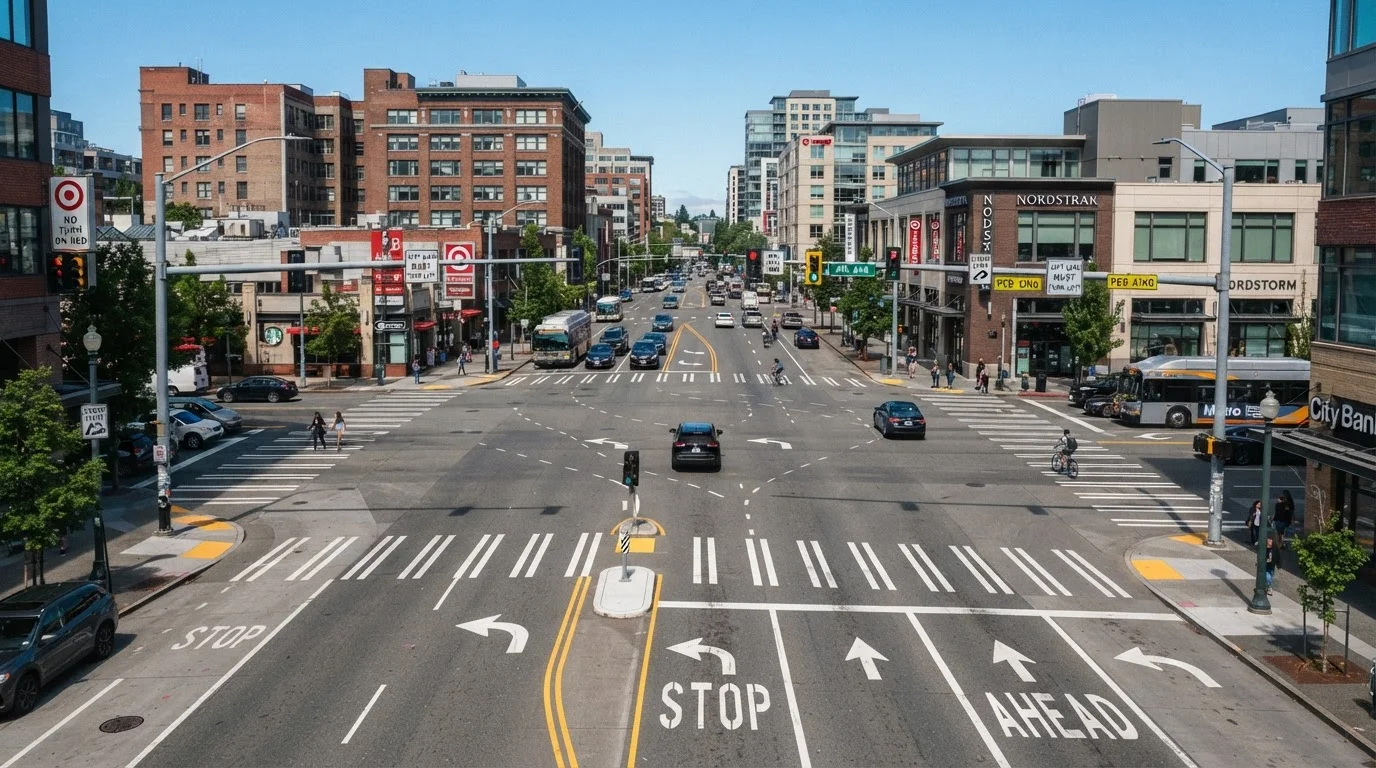
- White lines separate traffic moving in the same direction. A solid white edge line marks the right boundary of the travel lane. A broken white center line between lanes means lane changes are permitted when safe.
- Yellow lines separate opposing traffic. A solid double yellow line prohibits passing in either direction. A single solid yellow alongside a broken yellow means only the driver beside the broken line may pass.
- Crosshatch or diagonal hatching inside yellow or white borders marks a gore area — the triangular space between a departing lane and the main roadway. Driving through this area is prohibited.
- Solid white stop lines indicate exactly where a vehicle must stop at a signal or sign. Stopping beyond this line — even partly — can constitute a violation.
- Arrows in lanes indicate permitted movements. A shared turn-and-through arrow means both maneuvers are allowed from that lane; a curved arrow only means no through movement is permitted.
For a broader look at the systems that keep vehicles roadworthy between intersections, see our companion reference under-the-bonnet components every driver should know.
Lane Rules That Cause the Most Confusion
Several lane-use rules are widely misunderstood even by experienced drivers.
State Law Variations You Should Know
While the MUTCD provides a national framework, specific enforcement details — such as HOV hours, left-lane passing requirements, and bike-lane crossing rules — are set at the state and sometimes county level. Before driving in an unfamiliar state, it is worth checking that state's Department of Motor Vehicles handbook. Rules that seem identical may carry different penalties or exceptions depending on jurisdiction.
Keep-Right Rules on Multi-Lane Roads
Most states require drivers to stay in the right lane on divided highways except when passing. "Left lane for passing only" is not just a courtesy — in many states it is a primary offense, meaning officers can stop you solely for occupying the left lane while not overtaking. Rules vary by state; check your state's DMV handbook for the specific threshold (e.g., some states specify driving below the speed of traffic).
High-Occupancy Vehicle (HOV) Lanes
HOV lanes (also called carpool lanes) require a minimum number of occupants — typically two or three — during posted hours. The requirements, hours, and penalties differ by jurisdiction. Motorcycles are generally permitted regardless of occupancy in most states, but verify locally. Some facilities now operate as HOT lanes, allowing solo drivers to pay a toll.
Bicycle Lanes and Shared Lane Markings
A solid white line bordering a bike lane means motor vehicles may not enter except to cross at driveways or intersections. A sharrow (the shared-lane marking showing a bicycle with chevrons) does not designate an exclusive bike lane — it indicates a shared roadway and alerts drivers to expect cyclists in the lane.
Junction and roundabout lane selection is a separate category of confusion covered in depth at roundabout and junction priority rules. For road trip planning where you'll encounter varied state rules, the roadtripping hub offers additional context.
The content on this site is for informational purposes only and is not a substitute for professional advice. Always consult a qualified professional for guidance specific to your situation.