

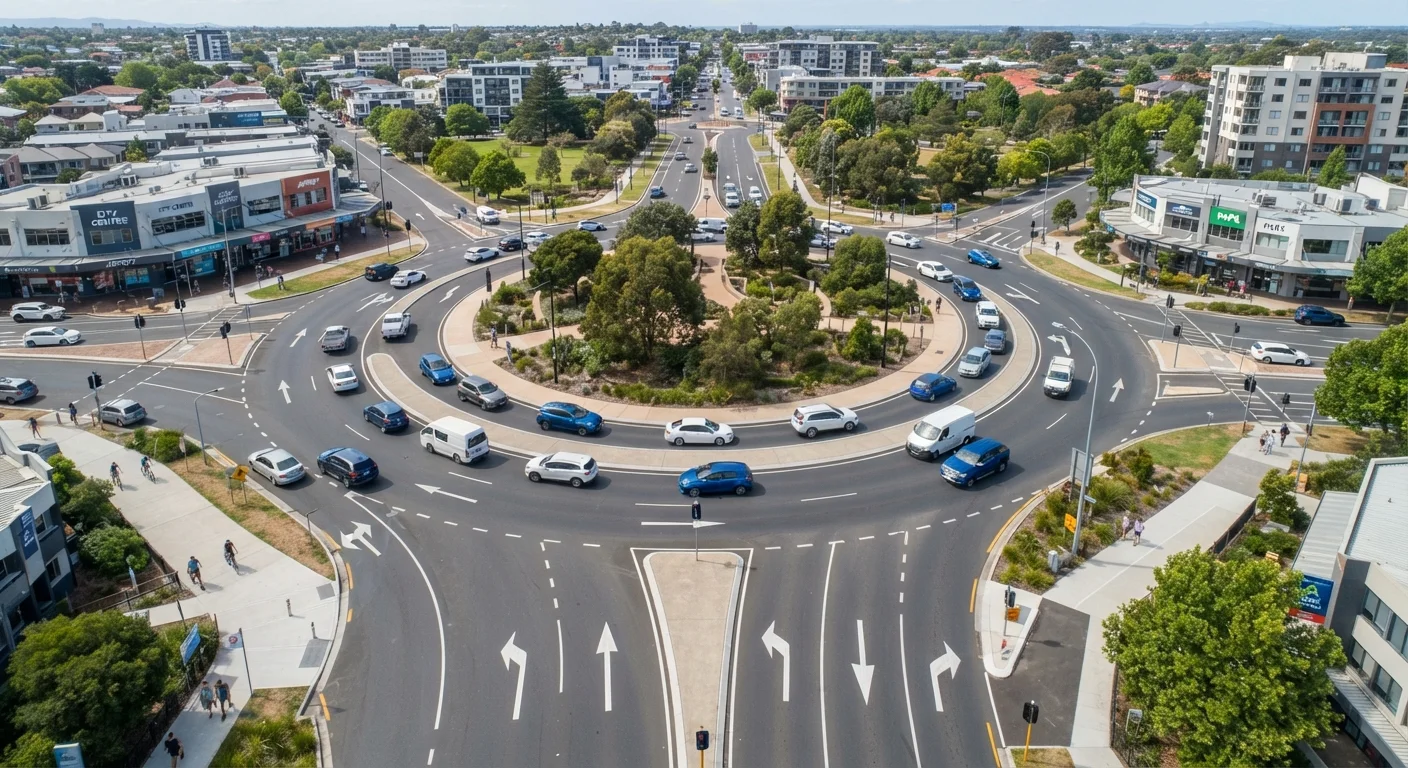
Why Priority Rules Cause So Many Collisions
Junction and roundabout collisions are among the most common in urban driving — and a significant share happen not because a driver was reckless, but because they misunderstood who had the right of way. Priority rules are well-established in traffic law, yet they are frequently misapplied by drivers of all experience levels.
| Most common cause of roundabout crashes | Failure to yield at entry (Federal Highway Administration roundabout guidance) |
| Four-way stop tiebreaker rule | Yield to the vehicle on your right (Standard across most U.S. state vehicle codes) |
| Roundabout injury crash reduction vs. conventional intersections | Up to 75% fewer (Insurance Institute for Highway Safety (IIHS)) |
| Emergency vehicle priority | Absolute — always yield and pull right (Required by law in all U.S. states) |
| Default priority at uncontrolled intersections | Yield to traffic approaching from the right (Majority of U.S. state vehicle codes) |
Part of the problem is overconfidence. Drivers who have navigated the same routes for years can develop habits that diverge from the actual rule. Another factor is ambiguity: some junction designs are genuinely unclear without road markings, and lane configurations at complex roundabouts can confuse even attentive drivers. Understanding the underlying principles — not just individual signs — is what produces consistent, safe decisions. For further context on how road markings support these rules, see our road markings and signs reference.
Roundabout Priority: The One Rule That Trips Drivers Up
In the United States, roundabout priority is clear: traffic already inside the roundabout has the right of way. Entering drivers must yield to circulating traffic before merging. Despite this, a common error is treating the roundabout entry as a first-come, first-served merge — particularly when drivers are accustomed to older traffic circle designs that operated on different rules.
Modern roundabouts use yield signs at every entry point, not stop signs. That distinction matters: yielding means adjusting your speed and timing to find a safe gap, not stopping unnecessarily when the roundabout is clear. Stopping without cause disrupts traffic flow and can cause rear-end collisions from vehicles behind.
Right of Way
The legal right of a vehicle or pedestrian to proceed through a junction or road section before others. It is granted by traffic law, signs, or signals — not claimed by aggression or assumption.
Yield
A legal instruction to slow or stop as needed and allow other traffic to pass before proceeding. Yielding does not mean stopping automatically — only when necessary to avoid a conflict.
Circulating Traffic
Vehicles already moving inside a roundabout. Under U.S. roundabout rules, circulating traffic always has priority over vehicles waiting to enter.
Uncontrolled Intersection
A junction with no traffic signals, stop signs, or yield signs. Priority at uncontrolled intersections is typically governed by state vehicle code, usually requiring a yield to traffic from the right.
T-Intersection
A junction where one road ends and meets a through road perpendicularly, forming a T shape. The driver on the terminating road generally must yield to through traffic.
Four-Way Stop
An intersection where all approaches have stop signs. Vehicles proceed in the order they arrived, with ties resolved by yielding to the vehicle on the right.
Multi-lane roundabouts add another layer of complexity. The general guidance is to choose your lane before entering based on your intended exit — left lane for early exits, right lane for exits past the halfway point — though specific painted arrows take precedence. Cutting across lanes inside the roundabout is a leading cause of sideswipe collisions, and it puts cyclists and pedestrians in the crosswalk at serious risk.
Junction Priority: T-Intersections, Stop Signs, and Uncontrolled Crossings
At a standard T-intersection, the road that ends (the stem of the T) is typically the minor road, and drivers on it must yield to traffic on the through road. This hierarchy holds even when there are no signs present — an uncontrolled T-junction defaults to the same logic under most state vehicle codes.
At four-way stop signs, priority follows a defined sequence:
- The first vehicle to stop and reach the intersection goes first.
- If two vehicles arrive simultaneously, the driver on the left yields to the driver on the right.
- If vehicles are directly opposite and both going straight, they may proceed together. A turning vehicle must yield to the oncoming straight-through vehicle.
A persistent error at four-way stops is "waving through" — gesturing another driver to go when it is actually your turn. This creates ambiguity, disrupts the sequence, and can contribute to collisions if both drivers act simultaneously. Defer to the established sequence rather than improvising.
"Waving Through" Creates Legal Ambiguity
Gesturing another driver to proceed when it is your right of way does not transfer legal responsibility if a collision results. Both drivers may share liability, and the sequence established by traffic law — not hand signals — governs who had priority. Always follow the formal rules rather than informal gestures at busy junctions.
Understanding these rules pairs well with broader situational awareness — particularly around blind spots. Learn how blind spots form and why mirrors alone are insufficient before you enter any busy junction.
Priority at Unmarked Intersections and Railroad Crossings
Unmarked intersections — where two roads of similar classification meet without signs or signals — are handled by the right-of-way-to-the-right rule in most jurisdictions: yield to any vehicle approaching from your right. This applies at residential grid intersections and rural crossroads alike. When in doubt, slow down enough to make eye contact and confirm the other driver's intention before proceeding.
Emergency vehicles override all standard priority rules. When you see or hear flashing lights or a siren, pull to the right and stop until the vehicle has passed — even if you are in a roundabout or intersection. Failure to yield to emergency vehicles is both illegal and dangerous.
At railroad crossings, trains always have absolute priority. Never attempt to beat a train regardless of perceived distance or speed. Signals, gates, and painted stop lines all exist to enforce a mandatory stop zone that should never be entered when a train is approaching.
For unexpected scenarios — including how to react when conditions deteriorate — see how wet and low-visibility conditions change your stopping distances and decision windows.
The content on this site is for informational purposes only and is not a substitute for professional advice. Always consult a qualified professional for guidance specific to your situation.