

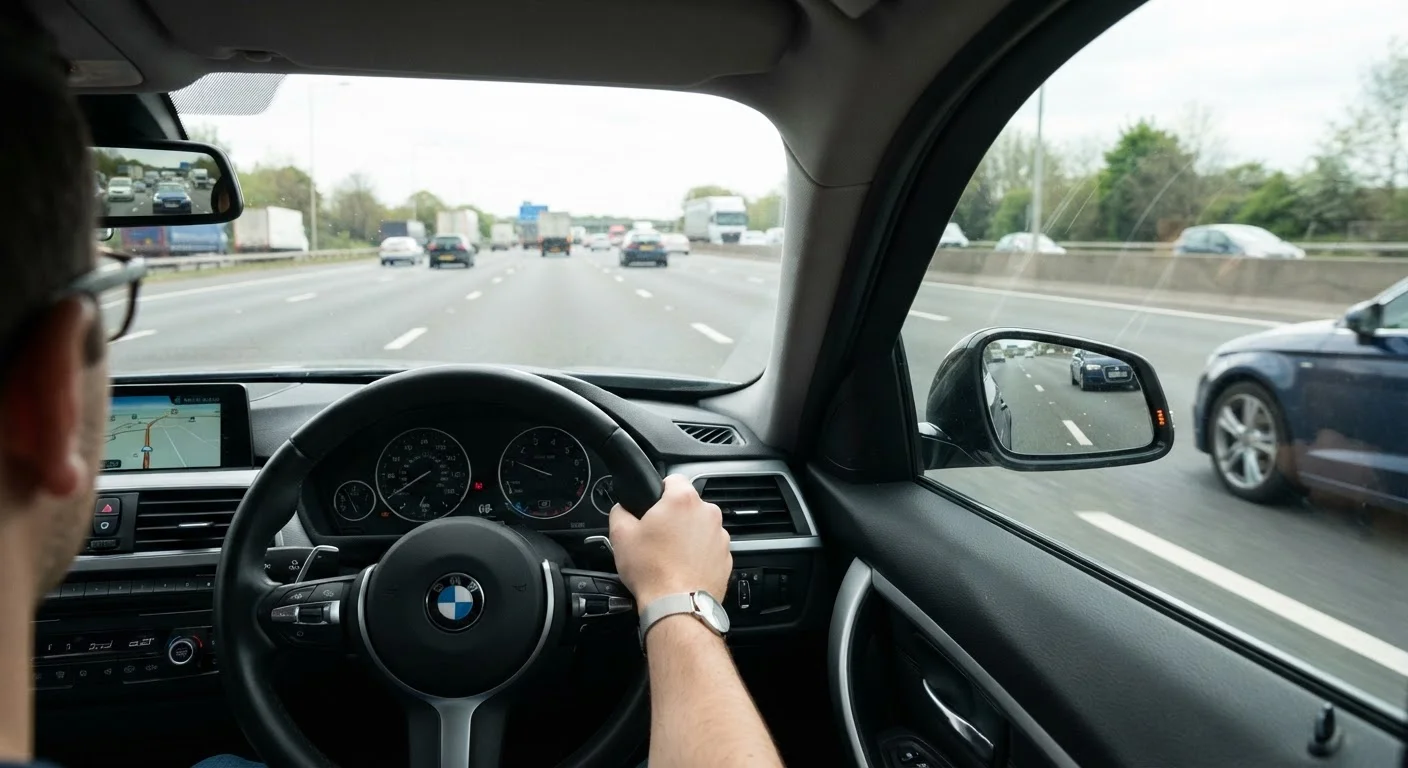
Why Mirrors Don't Tell the Whole Story
Most drivers assume that a quick glance at their mirrors before changing lanes is sufficient. It isn't. Mirrors are angled to give a rearward view, but the physics of reflection mean there is always a gap — a wedge-shaped zone on each rear side of the vehicle — where another car, motorcycle, or cyclist can sit completely out of frame.
The default mirror position taught to many new drivers — angled inward until the driver can see their own rear door — wastes a significant portion of available mirror coverage. That positioning shows you your own car, which you already know is there. Adjusting mirrors outward expands lateral coverage and narrows the blind zone, though it does not close it entirely.
Understanding this gap is the first step. The second is accepting that no mirror angle removes the need for a physical shoulder check before every lane change — every single time, at every speed.
Blind Spots Aren't Only About Lane Changes
While lane-change collisions are the most discussed blind spot scenario, drivers also face blind zones when turning at intersections (where the A-pillar can hide a pedestrian), reversing from parking spaces, and pulling out of driveways. Each of these situations requires its own form of deliberate visual check beyond mirror use alone.
The Geometry of a Blind Spot
To understand where blind spots form, picture the view from above. Your rearview mirror covers the center lane behind you. Each side mirror, correctly adjusted, covers the lane diagonally behind on its respective side. The problem is the transition zone: the area beside and slightly behind the vehicle that falls between the edge of the side mirror's coverage and the limit of your peripheral vision looking forward.
This zone is typically large enough to conceal an entire passenger vehicle traveling at highway speed. In SUVs and pickup trucks, the zone is larger still, partly because the higher seating position shifts the mirror angle and partly because wider body structures increase the gap. The A-pillar — the structural frame on either side of the windshield — adds a forward blind spot that obscures pedestrians and cyclists when turning at intersections.
840,000+
Annual US blind spot crashes estimated
The National Highway Traffic Safety Administration has attributed approximately 840,000 crashes per year to blind spot-related lane changes in the United States.
300 ft
Rear blind zone of a large semi-truck
Federal Motor Carrier Safety Administration guidance notes that the rear blind zone behind a large commercial truck can extend up to approximately 30 feet, and the side zones can span multiple lanes.
~2 sec
Time a vehicle can traverse a blind zone at speed
At typical highway speeds of 65 mph, a vehicle can move from outside a driver's mirror view to directly alongside the vehicle in under two seconds, leaving almost no reaction window if a lane change is already initiated.
Certain road situations amplify blind spot risk considerably. Multi-lane highways are the most obvious context, but merging ramps, roundabout exits, and urban lane splits all create moments where a vehicle might be traveling alongside you in your blind zone. Junction and roundabout collisions frequently involve drivers who checked their mirrors but skipped the shoulder check.
Who Gets Hit — and Why
Motorcyclists and cyclists bear a disproportionate share of blind spot casualties. Their narrower profile means they fit entirely within the blind zone that a car occupies only partially. A driver checking a mirror sees no obstruction and proceeds — without knowing a rider is already there.
The same dynamic plays out in reverse. Large commercial trucks have blind zones that extend across multiple lanes on both sides and can stretch nearly 30 feet ahead of the cab. Passenger car drivers who linger in those zones or cut in front too tightly are equally at risk, which is why highway safety guidance consistently advises: if you can't see a truck's mirrors, the driver cannot see you.
Fatigued or distracted drivers are more likely to skip the shoulder check, which is why blind spot incidents often cluster with broader attention failures. Driving while tired compounds blind spot risk significantly, because the tendency to rely on mirrors alone increases when alertness drops.
Spend Less Time in Others' Blind Zones
Being aware of your own blind spots is only half the equation. Avoid lingering alongside large trucks or buses where you know their lateral blind zones are. If you can't see the driver's face in their mirror, move through or drop back — don't sit there. This is equally protective on night drives where reduced visibility makes detection even harder.
Building the Habit: Checking Properly Every Time
Effective blind spot management comes down to a consistent sequence: mirrors first, then a brief but deliberate shoulder check — rotating your head to look directly into the blind zone — before initiating any lane change or merge. This takes about one second and provides the visual coverage that no mirror can supply.
Good mirror adjustment is the foundation. Set your side mirrors so the rear corner of your car just disappears from view at the inner edge; this pushes the mirror's field outward where it matters most. Combine this with the rearview mirror set to frame the full rear window, and you've minimised the gap before the shoulder check even begins.
Technology can assist. Blind spot monitoring systems — now common on many newer vehicles — use radar to detect vehicles in adjacent lanes and alert drivers with an indicator light in the mirror housing or an audible warning. These systems are genuinely useful, but they have detection limits and should not become a reason to stop performing shoulder checks. They work alongside good habits, not instead of them.
For broader situational awareness, a pre-trip mirror check ensures mirrors haven't shifted overnight — a simple step that takes seconds and eliminates an avoidable hazard before you've left the driveway. Conditions also matter: reduced visibility in rain, fog, or snow shrinks the margin for error when a vehicle emerges from your blind zone, making a disciplined check even more important.
Frequently Asked Questions
The primary blind spots are the diagonal zones on each rear side of the vehicle, roughly between where the side mirror's view ends and the driver's direct peripheral vision begins. Most vehicles also have a smaller blind spot created by the A-pillar on the front left side. The area directly behind the vehicle when reversing is a further concern, particularly in taller vehicles.
No. Blind spot monitoring systems use radar or cameras to alert drivers to vehicles in adjacent lanes, but they have limitations — they may not detect cyclists, motorcycles at speed, or vehicles approaching very quickly. They are a useful supplement, not a replacement for a physical shoulder check before any lane change.
Adjust your side mirrors outward further than most drivers do — until you can just barely see the rear corner of your own vehicle. This widens the lateral coverage and reduces the gap between mirror view and direct vision. Your rearview mirror should give a full view of the rear window without any adjustment from the driver's seat.
Yes. At highway speeds, a vehicle can travel from outside your mirror's field of view to alongside you in under two seconds. The margin for error when a driver changes lanes without checking is far smaller than in slow urban traffic, which is why lane-change crashes at speed tend to be more serious.
Motorcyclists and cyclists are statistically most vulnerable because their narrower profile means they disappear more completely into blind zones. Pedestrians crossing behind reversing vehicles — especially children — are also a major concern, particularly with larger vehicles that have extensive rear blind areas.
The content on this site is for informational purposes only and is not a substitute for professional advice. Always consult a qualified professional for guidance specific to your situation.