

The Vision Problem That Starts Before You Turn the Key
Human eyes are not engineered for driving in darkness. The cones that identify color and fine detail require substantial light to function — in low-light conditions, vision shifts largely to rod cells, which are more sensitive to movement and contrast but cannot distinguish color well. That shift has real consequences: road markings appear flatter, pedestrians wearing dark clothing become nearly invisible, and depth perception deteriorates.
Age amplifies every one of these effects. A driver in their 50s may need significantly more light to see clearly at night than they did at 30. Glare recovery — the time it takes to regain normal vision after an oncoming headlight flash — also increases with age. These are physiological realities worth accounting for, not limitations to dismiss.
Keeping your windshield and headlight lenses clean is one of the most overlooked night-driving preparations. A dirty windshield that appears transparent in daylight can scatter oncoming light into significant glare at night. Oxidized plastic headlight lenses reduce light output far more than most drivers realize. Dashboard warning lights can alert you to electrical faults affecting lighting systems — don't ignore them.
The Stopping-Distance Gap: Why Your Headlights Are Lying to You
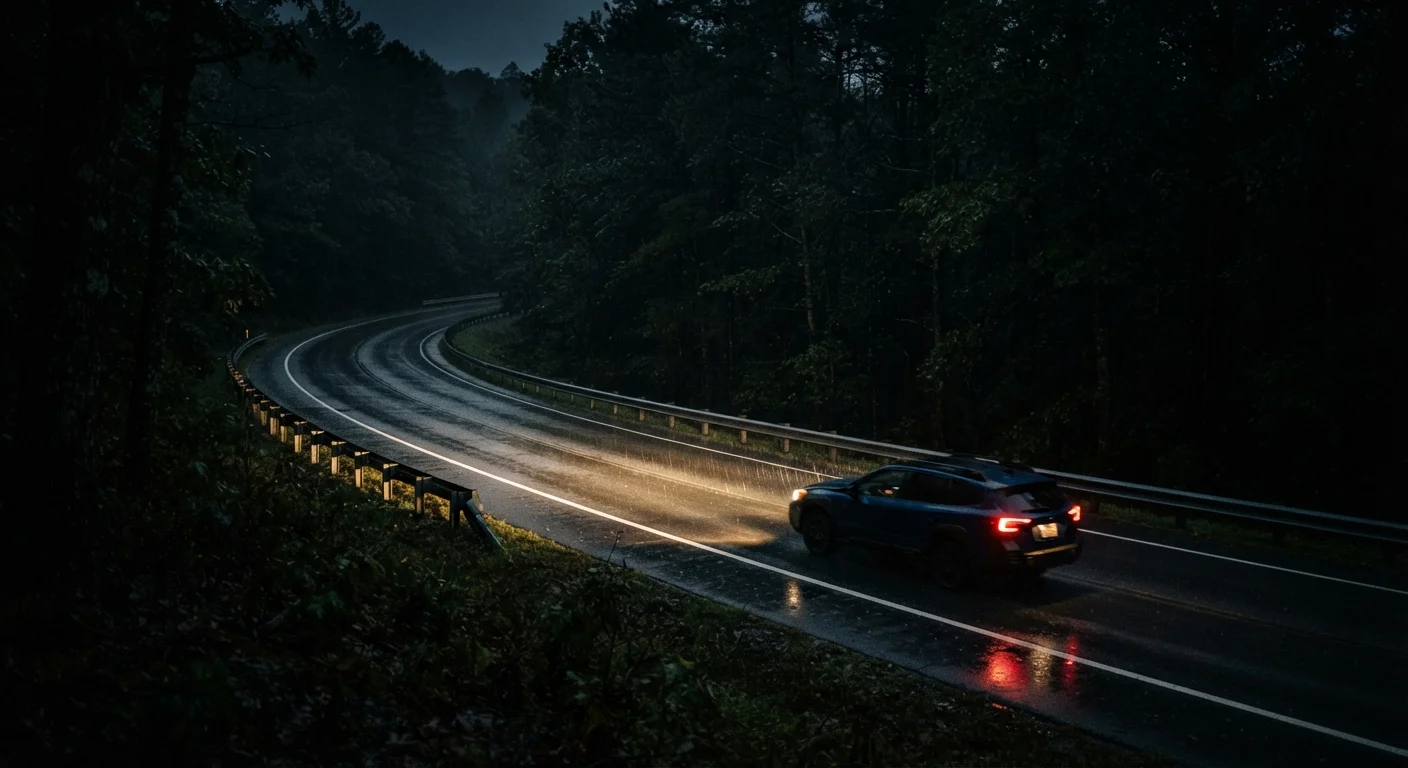
The phrase "overdriving your headlights" describes a specific and dangerous condition: traveling at a speed where your stopping distance exceeds the distance your headlights illuminate. It happens constantly, and most drivers doing it have no idea.
~2x
Higher fatality rate per mile driven at night vs. daytime
According to the National Safety Council, traffic fatality rates are roughly twice as high at night as during the day, despite lower overall traffic volumes.
160–200 ft
Typical low-beam headlight illumination range
The NHTSA and industry testing broadly confirm that standard low-beam headlights illuminate approximately 160 to 200 feet of road ahead — less on curves.
Standard low-beam headlights illuminate approximately 160 to 200 feet of road ahead. At 60 mph, the average vehicle with average braking on dry pavement requires roughly 300 feet or more to stop completely — accounting for both reaction time and braking distance. That gap between what you can see and what you need to stop is where serious crashes begin.
High beams extend visibility to approximately 350–500 feet and are the most underused safety tool on most vehicles. Many drivers leave them off out of habit or excessive caution about oncoming traffic, but on unlit rural roads with no approaching vehicles, high beams can double your hazard-detection window. Switch back to low beams when vehicles approach or when following closely behind another car, but use high beams liberally on dark, open roads.
Practices That Experienced Night Drivers Apply Consistently
The following practices close the gap between where your headlights reach and where danger actually starts.
Reduce speed until your stopping distance fits within your visible headlight range.
Overdriving your headlights is a leading contributor to nighttime single-vehicle crashes. Slowing down on unlit roads — even below the posted limit when conditions warrant — ensures you can respond to what your lights actually reveal. Speed limits are maximums for ideal conditions, not targets for darkness.
Use high beams proactively on open, unlit roads and switch promptly when traffic approaches.
High beams can more than double your detection range compared to low beams, giving you crucial additional seconds to identify hazards. Many drivers never switch out of low-beam mode, unnecessarily limiting their field of effective vision all night long.
Increase your following distance to at least four seconds behind the vehicle ahead.
Standard following-distance guidance increases at night because your perception of the vehicle ahead's speed and distance is less reliable in darkness. Brake lights offer limited information; four seconds of space provides buffer for reaction and braking.
Clean headlight lenses and windshields before night trips — inside and out.
Oxidized plastic headlight lenses can reduce light output dramatically. A hazy windshield that seems fine in daylight becomes a glare multiplier at night, scattering light from oncoming vehicles across your field of view.
Avoid looking directly at oncoming headlights — shift your gaze to the right edge of the road.
Looking directly into oncoming headlights causes temporary vision impairment that can last several seconds after the vehicle passes — during which time you are essentially driving semi-blind. The right road edge provides a reliable guide without the glare exposure.
Night driving and fatigue are inseparable risks. Most drowsy-driving incidents occur between midnight and 6 a.m. — exactly when visibility is lowest. The hidden risks of driving while tired include impaired reaction time and reduced lane discipline, both of which are more dangerous after dark. If you notice yourself drifting, yawning repeatedly, or struggling to maintain focus, treat that as a serious safety signal, not a minor inconvenience.
Quick Actions to Improve Your Night Safety Right Now
Rural and urban roads present distinct night-driving challenges. Rural and urban road hazards differ dramatically at night — unlit country roads hide deer, cyclists, and pedestrians with no ambient lighting, while city driving introduces confusing reflections, pedestrian unpredictability, and signal glare. Adjust your approach accordingly. For related conditions that compound night-driving risk, see our guide on driving in rain, fog, and snow.
The content on this site is for informational purposes only and is not a substitute for professional advice. Always consult a qualified professional for guidance specific to your situation.