

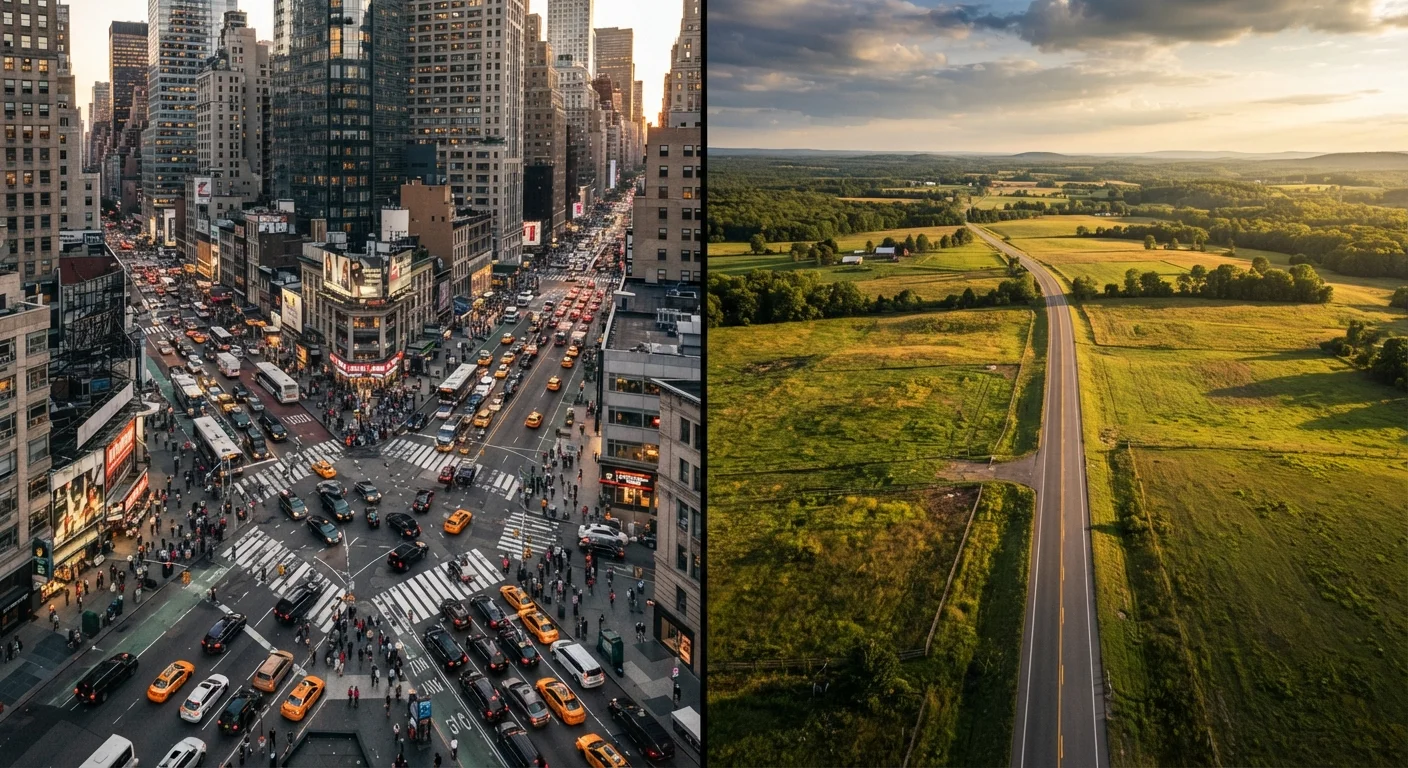
Our Verdict
Neither urban nor rural driving is categorically more dangerous — each environment carries hazards that the other largely doesn't. Urban roads demand constant attention to pedestrians, cyclists, and unpredictable stop-start traffic. Rural roads demand vigilance for wildlife, limited sight lines, and the false confidence that comes with open space and light traffic. The safest drivers treat every environment as its own problem to solve, never allowing familiarity or low speed to lower their guard.
| Best for | Recommended |
|---|---|
| Drivers navigating dense city streets | Urban Hazard Awareness |
| Drivers on open country roads and highways | Rural Hazard Awareness |
| Drivers regularly transitioning between environments | Adaptive Driving Mindset |
Why Environment Changes Everything
Driving at 40 mph through a city neighbourhood feels nothing like driving at 40 mph on a rural backroad — and that gap in felt experience reflects a genuine gap in risk structure. Speed limits are set for road type and legal context, but they can't account for every variable present at a given moment. As this guide to situational speed explains, posted limits represent a ceiling, not an ideal driving speed.
Understanding how hazards differ between urban and rural environments is not about favouring one road type over another — it's about matching your attention, speed choice, and reaction readiness to what the road is actually presenting.
~50%
Rural share of US traffic fatalities
The NHTSA reports that rural roads account for roughly half of all US traffic fatalities despite carrying a much smaller proportion of total vehicle miles travelled.
3x
Rural vs. urban fatality rate per mile
Research by the Insurance Institute for Highway Safety (IIHS) has consistently shown that the death rate per mile driven on rural roads is approximately three times that of urban roads.
Urban Road Hazards: High Frequency, Lower Margins
City driving is defined by density. Intersections arrive quickly, pedestrians step off kerbs unexpectedly, cyclists occupy lanes in varying positions, and parked vehicles can conceal everything from a reversing car to a child on a scooter. The hazard rate is high, but speeds are typically lower, which compresses stopping distances into a more manageable range — provided drivers are actively scanning.
Key Urban Risks
- Pedestrian and cyclist conflict: In dense areas, vulnerable road users cross and merge at unpredictable points, often outside marked crossings.
- Dooring: Parked vehicles can suddenly open a door into the roadway. Maintaining a buffer from parked cars is a consistent recommendation from road safety organisations.
- Intersection complexity: Multiple signal phases, turning vehicles, and pedestrian crossings create overlapping risk windows even when a driver has a green light.
- Distraction saturation: Signage, navigation prompts, storefronts, and other traffic compete for attention constantly.
Urban driving can also create a false sense of safety through low speeds. Low-speed collisions involving pedestrians still carry serious injury risk. Maintaining calm and assertive — not aggressive — driving behaviour matters especially in congested urban conditions where frustration runs high.
Scan Ahead, Not Just Ahead of You
In urban environments, it's tempting to focus only on the vehicle immediately in front. Instead, train yourself to track two or three vehicles ahead to anticipate brake lights, turning intentions, and merging behaviour before they become emergencies. This habit transfers directly to rural driving, where scanning beyond the next bend can reveal animals, equipment, or oncoming headlights in time to react.
Rural Road Hazards: Lower Frequency, Higher Severity
Rural roads present a different problem: hazards appear less often, but when they do, the consequences are frequently more severe. Higher travel speeds mean longer stopping distances, less time to react, and far more destructive crash forces. According to the National Highway Traffic Safety Administration (NHTSA), rural roads consistently account for a disproportionate share of traffic fatalities relative to total vehicle miles travelled.
Key Rural Risks
- Wildlife crossings: Deer, elk, and other animals enter roadways suddenly and unpredictably, particularly at dawn and dusk.
- Limited sight lines: Curves, crests, and tree lines can conceal oncoming vehicles, slow-moving farm equipment, or stopped cars until the last moment.
- Road surface variation: Rural roads may feature gravel shoulders, loose chip seal, unmarked dips, or sudden narrowing — none of which appear on a standard navigation display.
- Fatigue and monotony: Long, straight stretches with little visual input contribute to drowsiness and lane drift.
- Delayed emergency response: Medical and rescue services take longer to reach rural crash sites, increasing the severity of outcomes.
Rural driving also invites overconfidence. Light traffic and open space can feel safe, leading drivers to relax scanning habits or allow following distances to shrink. Conditions like fog, rain, and night amplify every rural risk — see how to adapt to conditions most drivers underestimate for a deeper look at this. Night driving on rural roads is particularly hazardous given reduced headlight reach on unlit, winding routes.
| Hazard Factor | Urban Roads | Rural Roads | |
|---|---|---|---|
| Hazard frequency | Very high — constant vigilance needed | Lower — but less predictable | |
| Typical crash severity | Often lower due to reduced speed | Higher due to elevated travel speed | |
| Primary hazard types | Pedestrians, cyclists, intersections | Wildlife, sight-line limits, fatigue | |
| Road surface consistency | Generally marked and maintained | Can vary significantly without warning | |
| Emergency response time | Typically faster | Often significantly delayed | |
| Driver fatigue risk | Lower — high stimulation | Higher — monotony promotes drowsiness | |
| Overconfidence risk | Low-speed complacency | Open-road complacency at higher speeds |
Adapting Your Driving Mindset Across Environments
The transition between urban and rural driving — and back again — is itself a risk window. Drivers who spend long hours on open rural roads and then re-enter urban areas may carry over rural scanning habits (slower frequency, longer gaze distances) that leave them underprepared for rapid close-range hazards. The reverse is equally true.
Practical Adaptation Habits
- Reset your following distance: Rural roads warrant longer following distances due to higher speeds. Urban roads require constant management of closing gaps.
- Adjust your scan pattern: Urban scanning is close and rapid. Rural scanning must extend further ahead and include field edges, roadsides, and oncoming lane positions.
- Manage speed proactively: Enter bends, crests, and intersections at a speed from which you could stop within your visible stopping distance — in both environments.
- Plan for fatigue on long rural legs: If a road trip takes you through extended rural stretches, build in rest stops rather than pushing through drowsiness.
Whether you're navigating city blocks or winding country lanes, the underlying principle is the same: drive to the conditions, not just the speed limit. For trips that combine both environments, understanding how weather interacts with different road types adds another layer of preparation worth reviewing before you set out.
The content on this site is for informational purposes only and is not a substitute for professional advice. Always consult a qualified professional for guidance specific to your situation.