

Why Weather Changes the Rules of the Road
Driving in clear conditions gives you margin for small errors. Bad weather eliminates that margin. Rain, fog, snow, and extreme heat each alter vehicle physics in different ways — and each demands a specific set of adjustments, not just generic caution. This reference covers the mechanics behind each condition and what changes you should actually make behind the wheel.
Before any long drive, a pre-trip vehicle check is especially important when weather is in the forecast. Worn wiper blades, low tire tread, or a weak battery are manageable problems in a parking lot and serious ones on a wet highway.
| Stopping distance increase on wet roads | Approximately 2× longer than dry pavement (General road safety guidance, NHTSA) |
| Stopping distance increase on ice | Up to 8–10× longer than dry pavement (Winter driving safety research, general consensus) |
| Recommended following distance in rain | 4–5 seconds (vs. 2–3 seconds in dry conditions) |
| Fog light rule | Use low beams, not high beams — high beams reflect off moisture |
| Heat's effect on tire pressure | Roughly +1 PSI per 10°F temperature rise (Tire industry standard guidance) |
| Hydroplaning typical speed range | Most common between 35–55 mph on worn tires |
Rain: Traction Loss and Hydroplaning
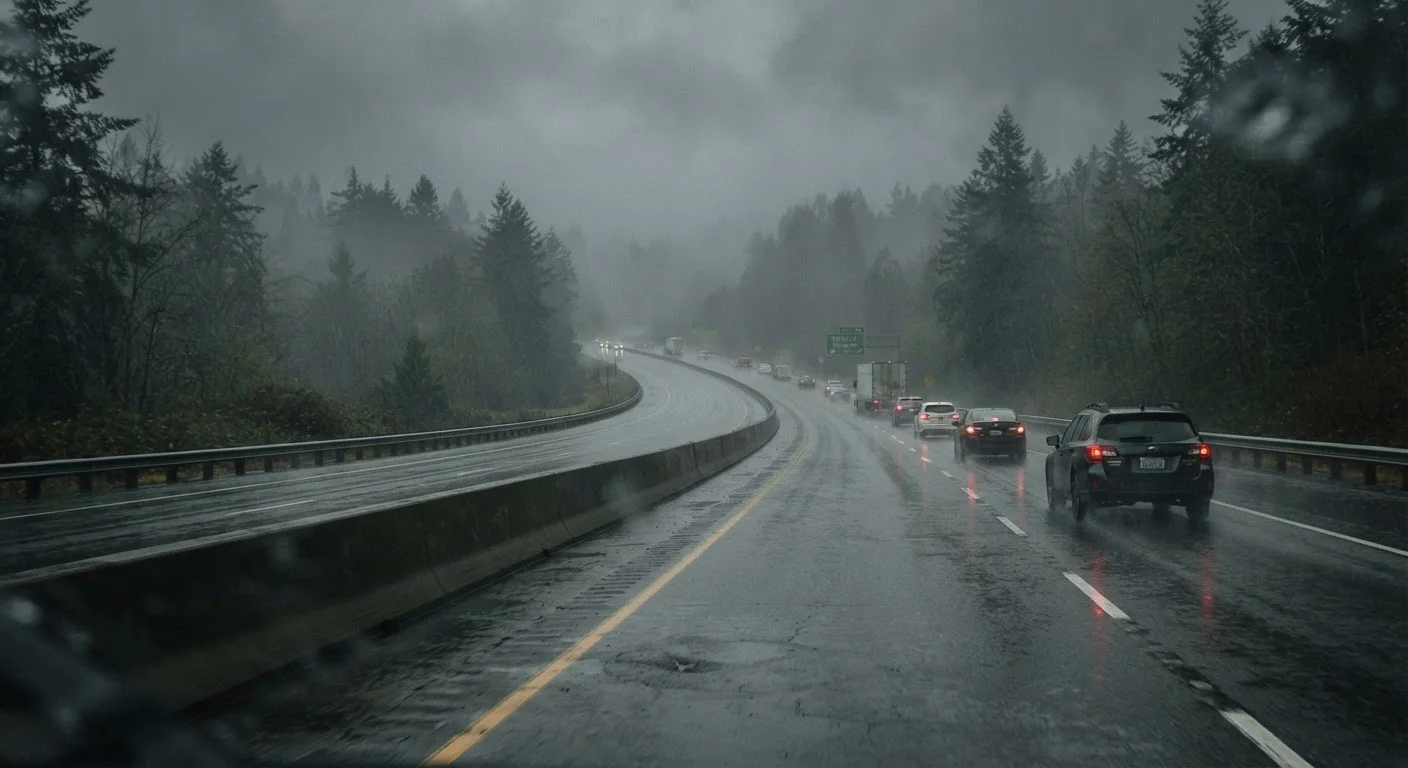
Rain is the most common hazardous condition US drivers encounter. The risk isn't just reduced visibility — it's the loss of tire grip on a surface that can become effectively frictionless when water accumulates faster than it disperses.
Hydroplaning occurs when a layer of water separates your tires from the road surface, causing steering and braking to momentarily stop working. It happens most often between 35–55 mph on worn tires or in standing water. If you feel the steering go light, ease off the accelerator gradually — do not brake sharply.
- Reduce speed by at least 5–10 mph below the posted limit on wet roads.
- Increase following distance to at least 4–5 seconds (versus the dry-road standard of 2–3).
- Turn on headlights — in most US states it's legally required when wipers are running.
- Avoid sudden lane changes; edges of lanes collect more water than wheel tracks.
Heavy rain can also reduce visibility to near-fog levels. The same guidance that applies to night driving and stopping distances translates here: if you can't see far enough to stop, you're going too fast.
Fog: The Visibility Problem Most Drivers Underestimate
Fog is particularly dangerous because it creates a false sense of security — the road ahead looks calm. The hazard is that you may not see a stopped vehicle, pedestrian, or sharp curve until you're already too close to stop.
Fog and High Beams: A Common Mistake
Switching to high beams in fog is a reflexive but counterproductive response. High-beam light scatters off suspended water droplets and creates a white wall effect, actually reducing how far ahead you can see. Always switch to low beams — or dedicated fog lights if your vehicle has them — as soon as visibility drops.
Use low-beam headlights in fog, not high beams. High beams reflect off water droplets and reduce your effective sight distance. Many newer vehicles have dedicated fog lights positioned lower on the bumper specifically for this reason.
- Drop speed significantly — aim to drive only as fast as your actual sight distance allows you to stop.
- Watch for the rear lights of vehicles ahead, but don't use them as your only speed reference — they may also be going too fast.
- Pull well off the road and turn off your lights if visibility drops below a safe threshold; staying on the shoulder with lights on can cause other drivers to follow you off the road.
Fog is especially common in valleys, near water, and in the early morning hours. Check forecasts for your route, not just your origin and destination.
Snow and Ice: When Stopping Distances Multiply
On packed snow, stopping distances roughly double compared to dry pavement. On ice, they can increase by eight times or more. All-wheel drive helps you accelerate on snow — it does nothing to help you stop or turn.
2×
Stopping distance on packed snow vs. dry road
Winter driving education resources consistently cite this as a baseline; actual distance depends on speed, tires, and surface.
75%
Of weather-related crashes occur on wet pavement
According to Federal Highway Administration data on weather-related vehicle crashes in the US.
- Black ice is transparent ice that forms on bridges, overpasses, and shaded stretches of road, often when air temperature is above freezing but the road surface is not. It looks like wet pavement.
- Slow down before curves, not during them — braking mid-corner on ice is one of the most common causes of winter spin-outs.
- If your vehicle skids, steer gently in the direction you want to go and avoid sharp inputs.
- Keep at least a half-tank of fuel in winter conditions — both for warmth if stranded and for added vehicle weight over the drive wheels.
For travel through consistently winter-affected regions — or international road trips like those through Iceland's unpredictable road conditions — understanding how surface conditions change by hour and elevation is essential, not optional.
If a skid or loss of control escalates into a larger emergency, the steps covered in handling blowouts and skids apply directly.
Heat: The Hazard That Doesn't Announce Itself
Extreme heat stresses vehicles in ways that build slowly and fail suddenly. Tire pressure increases with temperature — roughly 1 PSI per 10°F — which can push already over-inflated tires toward a blowout. Engine coolant systems under-performing in sustained high heat are a leading cause of summer roadside breakdowns.
- Check tire pressure before driving on hot days; heat adds to inflation, so start from a correct baseline.
- Monitor your temperature gauge on long climbs or in stop-and-go traffic. If it climbs toward the red, turn off the AC and turn on the heater — it draws heat away from the engine — and find a safe place to stop.
- Never leave passengers, children, or animals in a parked vehicle in heat. Cabin temperatures can reach dangerous levels within minutes.
Heat also compounds driver fatigue, which impairs reaction time in ways that mirror other impairments. On long summer road trips, plan rest stops more frequently than you think you need them.
This article provides general driving information for educational purposes. Always consult your vehicle's owner manual and follow the traffic laws of the state or jurisdiction you are driving in. Conditions vary; verify local road conditions and advisories through official sources before traveling.
The content on this site is for informational purposes only and is not a substitute for professional advice. Always consult a qualified professional for guidance specific to your situation.