

Start here
What Makes Motorways Different
Core skill
Lane Discipline: The Core Rule
Practice this
Joining a Motorway Safely
Then this
Leaving the Motorway Without Drama
Be prepared
When Something Goes Wrong
What Makes Motorways Different
Motorways — known as highways or freeways in US contexts — operate at higher sustained speeds, carry heavier traffic volumes, and impose stricter rules than ordinary roads. There are no traffic lights, no pedestrians, no cyclists, and no at-grade intersections. Entry and exit happen only at designated slip roads. These factors combine to make motorway driving feel intimidating at first, but they also create a predictable, controlled environment once you understand the conventions.
The higher speed means that errors — a sudden brake, an unannounced lane change, a late exit — have less time to be absorbed safely. This is why lane discipline and smooth, signalled movements matter so much more here than on urban roads. Before your first motorway journey, it's worth reviewing road markings and lane rules so the basics are already familiar.
Hard shoulder
A paved strip running alongside the outermost travel lane, reserved for emergencies and breakdowns — not for regular driving or stopping.
Acceleration lane
The slip road that runs parallel to the main carriageway, allowing drivers to build speed before merging into live traffic.
Lane discipline
The practice of occupying the correct lane for your speed and purpose — staying left (or right, depending on jurisdiction) unless actively overtaking.
Two-second rule
A minimum following-distance guideline: ensure at least two seconds of travel time exist between your vehicle and the one ahead.
Undertaking
Passing another vehicle on the inside (the slower side), which is generally prohibited on motorways and carries significant collision risk.
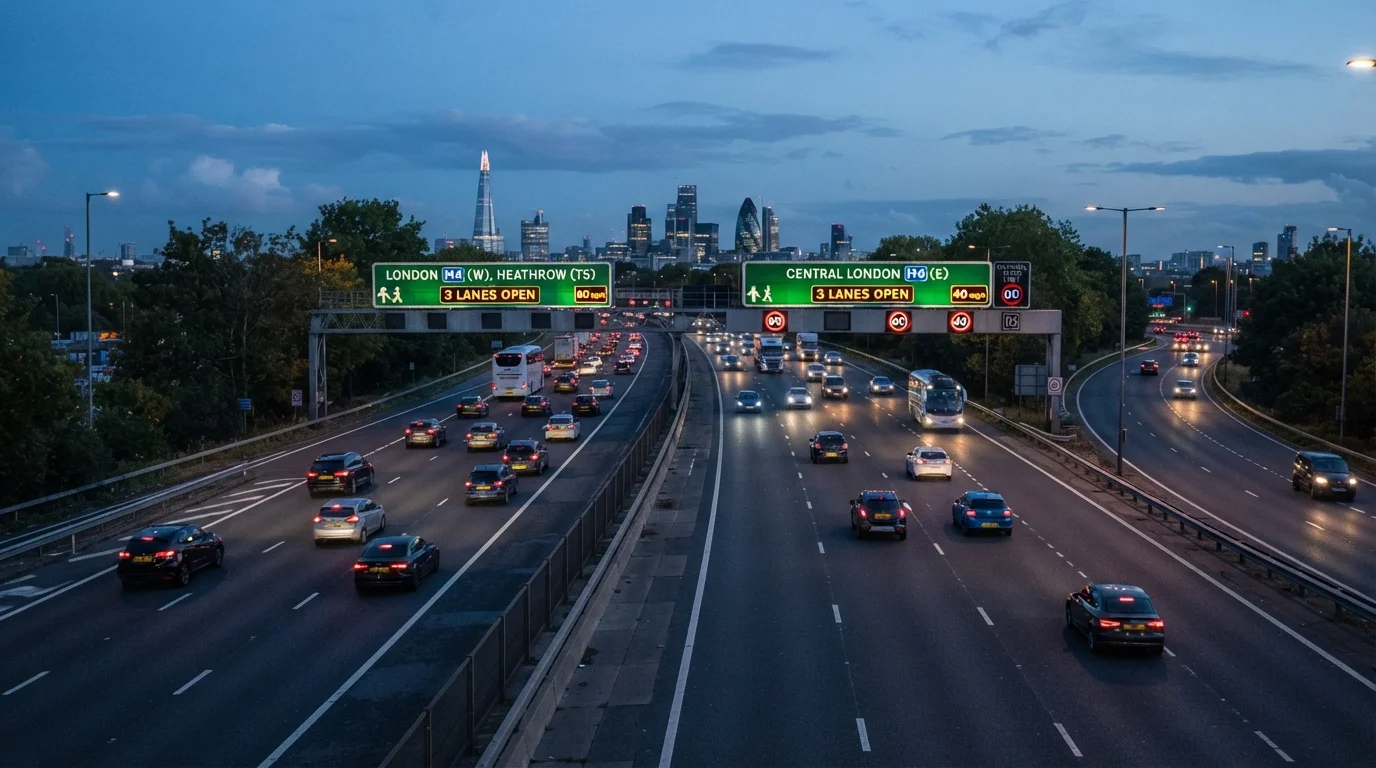
Gantry signs
Electronic signs mounted on overhead frames above each lane, used to display speed limits, warnings, lane closures, or other live traffic instructions.
Lane Discipline: The Core Rule
The fundamental motorway rule is simple: keep to the right-hand lane (or left-hand lane in left-hand-traffic countries) unless you are overtaking. In the US, slower traffic keeps right; faster traffic passes on the left. Once you have completed an overtake, move back to the right. Sitting in a middle or left lane when the right lane is clear is called middle-lane hogging, and it is both a traffic violation and a hazard because it compresses usable road space and tempts others to undertake.
Maintaining a safe following distance is equally non-negotiable. At motorway speeds, use the two-second rule as your minimum gap in dry conditions — double it in rain. Scan well ahead, not just the bumper in front of you, so you can respond to slowing traffic early rather than braking sharply.
Lane changes should always be signalled in advance, checked with mirrors and a shoulder glance for blind spots, then executed smoothly. Erratic weaving is one of the most common triggers for motorway near-misses. If you feel the urge to change lanes frequently, consider whether you're travelling at an appropriate and consistent speed for the conditions.
Check Gantry Signs Lane by Lane
Overhead gantry signs apply individually to the lane below them — a speed limit or red X shown above your lane applies to you even if adjacent lanes are unrestricted. Make it a habit to glance at the gantry as you approach rather than assuming a clear lane ahead means no restriction.
Joining a Motorway Safely
The acceleration lane (slip road) exists for one purpose: to bring your speed up to match traffic on the main carriageway before you arrive. Many new drivers make the mistake of reaching the merge point still travelling significantly slower than motorway traffic — creating a dangerous speed differential. Aim to be at or near the prevailing flow speed as you approach the broken white line where the slip road meets the main lane.
As you accelerate, use your mirrors to identify a gap in the left lane. Signal early so drivers already on the motorway can see your intention. If no gap is immediately available, adjust your speed within the acceleration lane — slow slightly to let a gap open rather than forcing your way in. Give way to traffic already on the motorway; they do not have to create space for you, though many will.
Once you've merged, resist the urge to immediately move to a faster lane. Settle, check your mirrors, confirm your following distance, and allow a moment to calibrate your speed perception — motorway speeds can feel slower than they are once you're embedded in the flow.
Leaving the Motorway Without Drama
Exits are signed in advance — typically at the one-mile and half-mile markers, then again at the exit itself. Start moving to the right-hand lane (closest to the exit) well before the half-mile sign, not as you draw level with the exit. Last-minute lane changes across multiple lanes are a leading cause of motorway incidents.
Once you are in the correct lane, signal your intention and move onto the deceleration lane — the slip road leading off the motorway. Do not brake sharply on the main carriageway. Reduce speed progressively once you are fully in the deceleration lane. After the extended speeds of motorway travel, urban limits can feel deceptively slow; check your speedometer rather than relying on how fast you feel you're going.
Never Reverse on a Motorway
If you miss your exit, it is illegal and extremely dangerous to stop, reverse, or attempt a U-turn on a motorway. Continue to the next junction and re-join in the correct direction. No time saving is worth the collision risk that reversing creates.
For a broader look at navigating exits, roundabouts, and priority junctions after you leave the motorway, our article on junction and roundabout priority rules covers the conventions that trip up even experienced drivers.
When Something Goes Wrong
Despite best preparation, emergencies happen. If your vehicle develops a problem — tyre blowout, warning light, loss of power — signal left immediately, reduce speed gently, and aim for the hard shoulder. If you can reach a service area, that is always the safer option. Once stopped on the hard shoulder, switch on hazard lights, exit from the passenger-side door away from traffic, move behind the barrier if one exists, and call for roadside assistance. Never stand between your vehicle and live traffic.
For a full step-by-step breakdown sequence, see our dedicated guide on motorway breakdowns and hard shoulder safety.
Finally, remember that confident driving is not the same as aggressive driving. Assertive, well-signalled lane changes and firm but smooth speed management are skills — not aggression. Our article on road rage versus assertive driving clarifies the distinction and helps you stay composed around hostile drivers.
Safety Tech Is Not a Substitute
Features such as lane-keeping assist and adaptive cruise control can support attentive driving, but they are not designed to manage motorway situations independently. For a fuller picture of where these systems fall short, see our article on over-relying on vehicle safety tech.
Once you're comfortable with motorway basics, the skills transfer naturally to longer journeys. Our first long-distance road trip primer is the logical next step.
Frequently Asked Questions
Yes. In the US and most jurisdictions, slower vehicles must keep right (or left in the UK), and the center lane is for overtaking only. Unnecessary middle-lane driving can attract enforcement action and creates dangerous situations by forcing others to undertake.
You should aim to match the speed of traffic already on the motorway before you merge — typically at or near the posted speed limit. Merging too slowly creates a speed differential that increases collision risk significantly.
The two-second rule is a common minimum: pick a fixed point ahead and ensure two full seconds pass between the vehicle in front passing it and you reaching it. In wet weather, extend this to four seconds.
Continue to the next exit — never reverse on a motorway, as this is extremely dangerous and illegal. Use the next junction to turn around and re-join in the correct direction.
Cruise control can reduce fatigue on long, straight sections, but new drivers should gain confidence in managing their own speed first. Remember that cruise control is an aid, not a substitute for active attention — always keep hands on the wheel and eyes scanning ahead.
The hard shoulder is strictly for genuine emergencies or mechanical failure — never for resting, phone calls, or routine stops. If your vehicle is capable of reaching a service area, do so rather than stopping on the hard shoulder.
The content on this site is for informational purposes only and is not a substitute for professional advice. Always consult a qualified professional for guidance specific to your situation.