

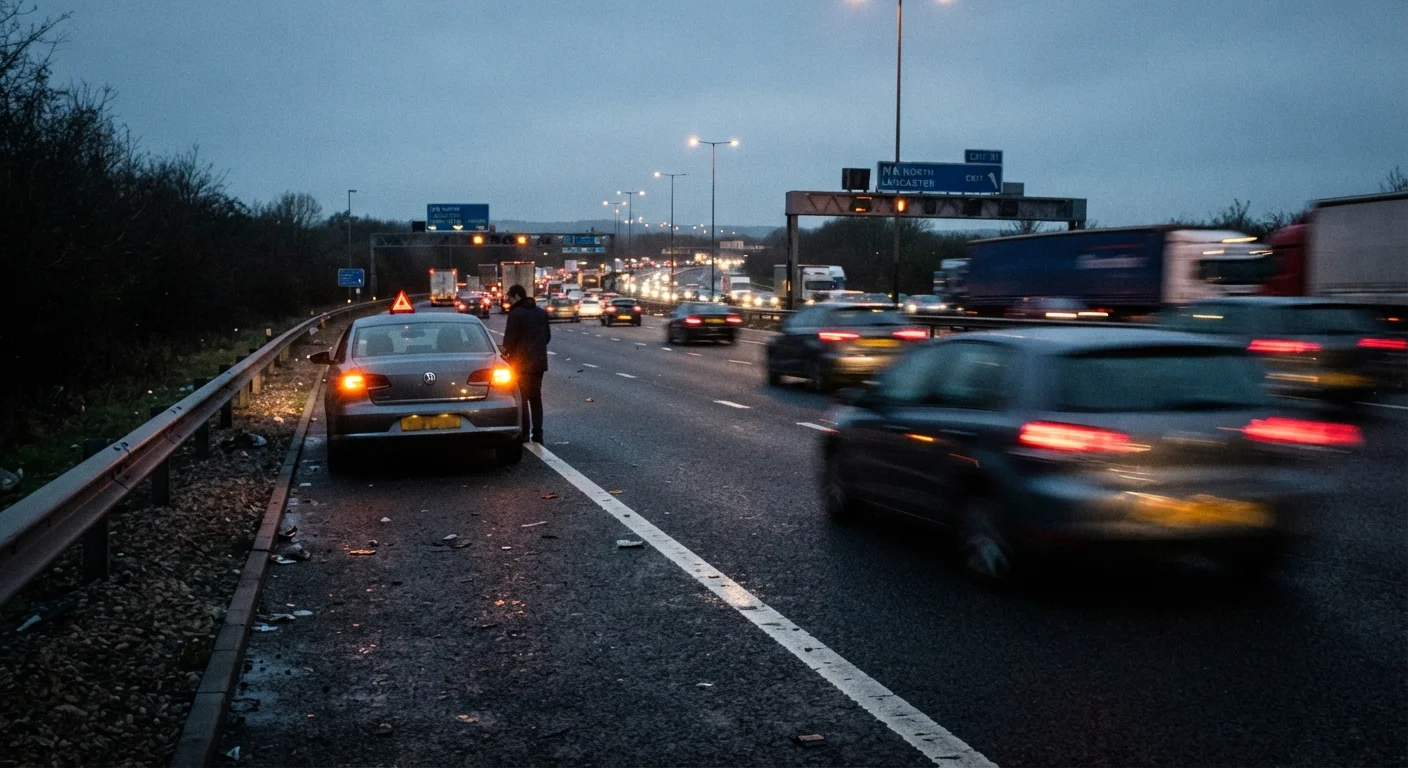
Why Motorway Breakdowns Are Especially Dangerous
Breaking down at low speed on a quiet street is stressful. Breaking down on a motorway is categorically more dangerous. Traffic passes within feet of the hard shoulder at speeds exceeding 60 mph, and the proximity of fast-moving vehicles creates a significant risk of being struck — both for drivers and for emergency responders. Reaction times at motorway speeds leave very little margin for error.
Studies from road safety organisations consistently identify the hard shoulder as one of the highest-risk locations for pedestrian fatalities on the road network. That risk is compounded on smart motorways — stretches where the hard shoulder has been converted to an active running lane — where the emergency refuge areas (ERAs) may be spaced more than a mile apart. Understanding the correct sequence of actions before you ever need them is essential. As the saying goes in road safety circles: the time to learn the drill is not when you are in the situation.
This guide also complements motorway driving fundamentals, which covers lane discipline and safe merging — skills that overlap with knowing how to exit a lane safely when something goes wrong.
Smart Motorways Change the Rules
On stretches of smart motorway where the hard shoulder operates as a running lane, stopping on that lane — even in an emergency — puts you in the path of live traffic. If you cannot reach an ERA, switch on your hazard lights immediately and call 999. Overhead gantry signs can be used by traffic operators to close the lane above you once they detect a stopped vehicle, but this takes time.
What You Need Before Every Journey
The best motorway breakdown response begins before you leave home. A quick vehicle check — tyres, fluids, lights, and fuel level — takes less than five minutes and can catch the conditions most likely to strand you. Our pre-trip safety walkthrough covers exactly what to look at and why it matters.
Beyond vehicle condition, every driver should keep a few items accessible in the car at all times:
What you will need
If a tyre blowout triggers your breakdown, the scenario has its own specific dynamics. See our guide on what to do during a highway tyre blowout for the correct steering and braking response before you reach the hard shoulder.
Step-by-Step: The Safe Breakdown Sequence
Follow these steps in order. Each one builds on the last, and skipping ahead can place you in greater danger. For a broader breakdown response applicable to all road types, the full roadside breakdown guide provides useful additional context.
Signal and move left as early as possible
The moment you notice a problem — loss of power, a blowout, a warning light — indicate left and begin moving toward the hard shoulder calmly and progressively. Do not brake sharply. If you are in an outer lane, move across lanes one at a time, checking mirrors and signalling clearly. Aim to reach the hard shoulder before speed drops so you have steering and braking control throughout.
Position the car as far left as possible
Pull the vehicle as close to the left-hand verge or barrier as safely achievable. The more distance between your car and the live carriageway, the safer everyone inside will be. Apply the parking brake, switch on your hazard lights, and if possible turn your front wheels toward the verge — if struck from behind, this steers the vehicle away from traffic rather than into it.
Exit the vehicle immediately — left side only
Do not exit through the right-hand door into the live lane under any circumstances. All occupants should leave through the left-side doors. Passengers should exit first; the driver exits last after ensuring everyone is out. Take your phone and any essential medication with you. Leave everything else in the car.
Move well away from the vehicle and carriageway
Walk up the verge and get as far from the hard shoulder as the terrain allows — ideally behind the safety barrier. If there is no barrier, move up the grass bank and away from the edge. Face oncoming traffic so you can see approaching vehicles, and keep a clear path to move further away if needed. Do not stand behind the vehicle or between the car and traffic.
Deploy a warning triangle if it is safe to do so
If you have a warning triangle and it is safe to access the boot without entering the live carriageway, place it approximately 45 metres behind the vehicle on the hard shoulder. This gives approaching drivers an earlier visual cue. However, never walk back along a live motorway lane to place a triangle — your safety takes precedence over any equipment deployment.
Call for assistance from behind the barrier
Once you and all passengers are safely away from the vehicle, call your breakdown provider or, if there is any risk to life, dial 911 (or 999 if you are in the UK). Give your location using motorway marker post numbers if visible, the motorway name and direction of travel, and a description of your vehicle. Stay on the line if instructed to do so, and remain at a safe distance until help arrives.
Inform Your Breakdown Provider Promptly
Calling your breakdown provider as soon as you are safely away from the vehicle — rather than after assessing the car — means help is dispatched sooner. Providers can often give an estimated arrival time quickly, which helps you plan how long you will be waiting in an exposed location.
After Help Is Called: Staying Safe While You Wait
Once you have called for assistance, your primary task is to remain safe until help arrives. Do not return to the vehicle to retrieve items, check the engine, or sit in the driver's seat. If the weather is severe and remaining outside is genuinely dangerous, get back into the car via the left-side door, keep your seatbelt on, and stay in the left-hand seat — not the driver's seat — so that if the car is struck from behind, you are not in the direct impact zone.
Keep your phone charged and with you, and be ready to give your exact location. Motorway marker posts (small posts placed roughly every 100 metres on the hard shoulder) display a unique reference number that you can relay to the emergency services or your breakdown provider to give a precise location. The routine vehicle maintenance hub is worth bookmarking — keeping your car in good condition is the single most effective way to reduce the chance of being in this situation at all.
Never Re-Enter the Carriageway on Foot
Under no circumstances should you walk along a live motorway lane — not to retrieve a warning triangle, flag down help, or inspect the vehicle. This applies even if traffic appears light. Emergency services will reach you; your job is to stay visible and safe from behind the barrier until they do.
The content on this site is for informational purposes only and is not a substitute for professional advice. Always consult a qualified professional for guidance specific to your situation.