

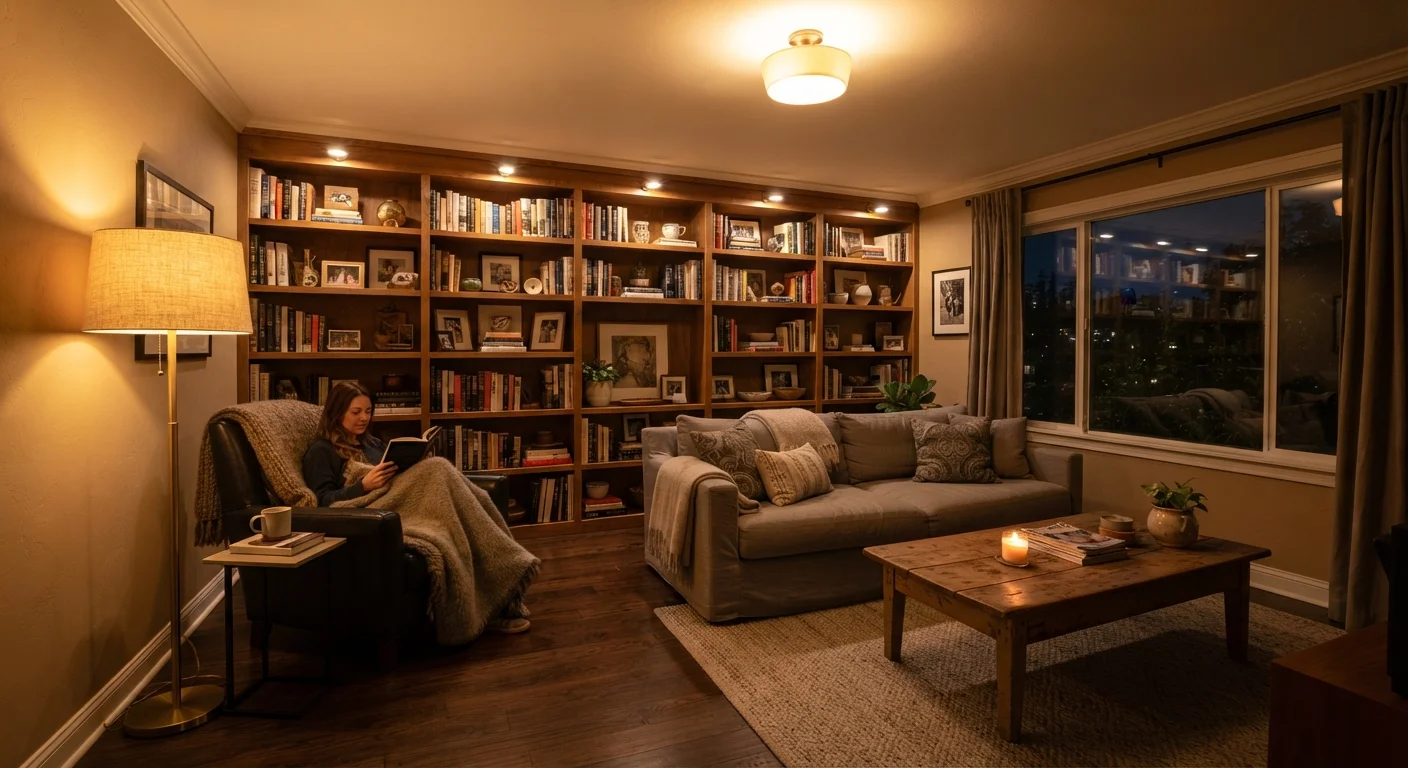
The Problem With One Overhead Light
Walk into almost any rental apartment or builder-grade home and you'll find the same setup: a single ceiling fixture centered in the room. It's serviceable in the sense that it produces light — but it also makes a room feel flat, clinical, and oddly uncomfortable, especially in the evening.
The reason has to do with shadows. Natural daylight enters a room from multiple angles, creating soft gradients and depth. A single overhead fixture obliterates that depth by flooding the room uniformly from one direction. Everything is equally bright, which paradoxically makes spaces feel smaller and less inviting. It's the lighting equivalent of overexposure in photography.
This is why layering matters. As the relationship between light and color in a room is more nuanced than it first appears, so is the relationship between light sources and how a space feels to live in.
Start With What You Already Have
Before buying anything, turn off your overhead fixture and rely only on whatever lamps and secondary sources you already own. Walk around the room and note where light is missing and where you naturally want to sit or work. That audit tells you where to invest first — and often reveals that one well-placed floor lamp is more valuable than a new ceiling fixture.
The Three-Layer Model Explained
Interior lighting designers have long organized light sources into three functional categories. Understanding each one makes it much easier to diagnose what your room is missing.
Ambient Lighting
Ambient light is the base layer — the general illumination that lets you move safely around the room. Ceiling fixtures, recessed downlights, and flush-mount pendants typically serve this role. The goal isn't brightness for its own sake; it's a comfortable, even wash of light across the room's floor plan.
Task Lighting
Task lighting is focused and functional. It sits closer to where you actually work, read, cook, or apply makeup. Desk lamps, under-cabinet kitchen lights, floor lamps positioned beside reading chairs, and vanity mirrors with integrated lighting all fall into this category. Task light is brighter and more directional than ambient light, and it reduces eye strain when you're concentrating.
Accent Lighting
Accent lighting is the detail layer — the one most people skip and the one that does the most to make a room feel considered. Directed spotlights, picture lights, lit shelving, and LED strip lighting tucked behind furniture all create focal points that draw the eye. Accent light should be roughly three times as bright as ambient in the area it targets to achieve the contrast that makes it effective.
3×
Accent light intensity vs. ambient
Lighting designers generally recommend accent lighting be approximately three times brighter than surrounding ambient light to create effective contrast and visual interest.
2700–3000K
Ideal color temp for living rooms
The Illuminating Engineering Society (IES) notes that warmer color temperatures in this range are broadly associated with relaxation and comfort in residential spaces.
~30%
Energy reduction possible with dimmers
According to the U.S. Department of Energy, dimming a light source by 25% can reduce energy consumption by roughly 20%, with greater savings at deeper dim levels.
Practical Ways to Add Layers Without Rewiring
You don't need to tear into walls or hire an electrician to start layering. The majority of what makes layered lighting effective can be achieved with plug-in fixtures.
- Floor lamps: Position one in a corner at roughly eye level when seated. A shade that directs light upward (a torchière style) adds ambient bounce; one that points downward focuses task light.
- Table lamps: Placing lamps at two different heights — say, a shorter one on a side table and a taller one on a console — immediately adds depth.
- Plug-in sconces: These mount on the wall with no wiring required. They're especially useful in bedrooms and hallways.
- LED puck lights or strip lights: Inexpensive and adhesive-backed options can light the inside of bookshelves, under kitchen cabinets, or along the toe kick of an island.
Pairing these with dimmers — even plug-in dimmer adapters — gives you meaningful control over the room's atmosphere across different times of day. This flexibility is what transforms a space from merely lit to genuinely comfortable. It also works in tandem with other design decisions: layering textures like fabric, wood, and metal creates richness that varied lighting will highlight and animate.
Putting It All Together
A workable approach is to audit each room by layer. Ask: where does my ambient light come from, and is it dimmable? Where do I actually perform focused tasks, and is there a light source close to that spot? And finally — what in this room is worth highlighting, and what light source currently does that?
Most people find the accent layer is what they've been missing. A single plug-in picture light or a spotlight aimed at a plant in the corner can transform the evening mood of an entire room without changing anything structural.
Color temperature is worth considering at this stage too. All three layers should ideally use bulbs in a similar color temperature range so the light reads as coherent rather than chaotic. Choosing the right white for your walls is similarly affected by whether your bulbs lean warm or cool, so it's worth thinking about both together.
“Light is not just something you see by. It shapes the architecture of a room — it determines what you notice, what you ignore, and how long you want to stay.”
— Mark Major, Lighting designer and co-author of 'The Lit Interior'
One common misconception worth addressing: layered lighting doesn't mean more light. It means more intentional light. You may end up running fewer watts total than a single 100-watt incandescent equivalent — but the room will feel more alive, not darker. That counterintuitive result is what makes the three-layer model one of the most impactful and underused tools in everyday home design.
Frequently Asked Questions
The three layers are ambient, task, and accent. Ambient provides general illumination for navigating a room. Task lighting focuses light where you need it most — at a desk, over a kitchen counter, or beside a reading chair. Accent lighting highlights specific features like artwork, shelving, or architectural details.
There's no single correct number, but most designers recommend at least one source per layer as a starting point. A living room might have a ceiling fixture (ambient), a floor lamp by the sofa (task), and a picture light or shelf spotlight (accent). Larger rooms typically benefit from multiple sources within each layer.
Not necessarily. Swapping in floor lamps, table lamps, plug-in sconces, and puck lights requires no electrical work and can dramatically change a room. For hardwired fixtures or dimmer switches, it's worth consulting a licensed electrician, especially in older homes.
Warmer color temperatures — roughly 2700K to 3000K — are generally preferred for living rooms and bedrooms because they feel cozy and relaxing. Kitchens and home offices often work better with slightly cooler light around 3000K to 3500K to support concentration and visibility.
Dimmers are widely considered one of the simplest upgrades for improving a room's atmosphere. They give you the flexibility to shift from bright functional light during the day to softer, warmer light in the evening. Most standard dimmers are compatible with LED bulbs, though you should verify compatibility before purchasing.
The content on this site is for informational purposes only and is not a substitute for professional advice. Always consult a qualified professional for guidance specific to your situation.