

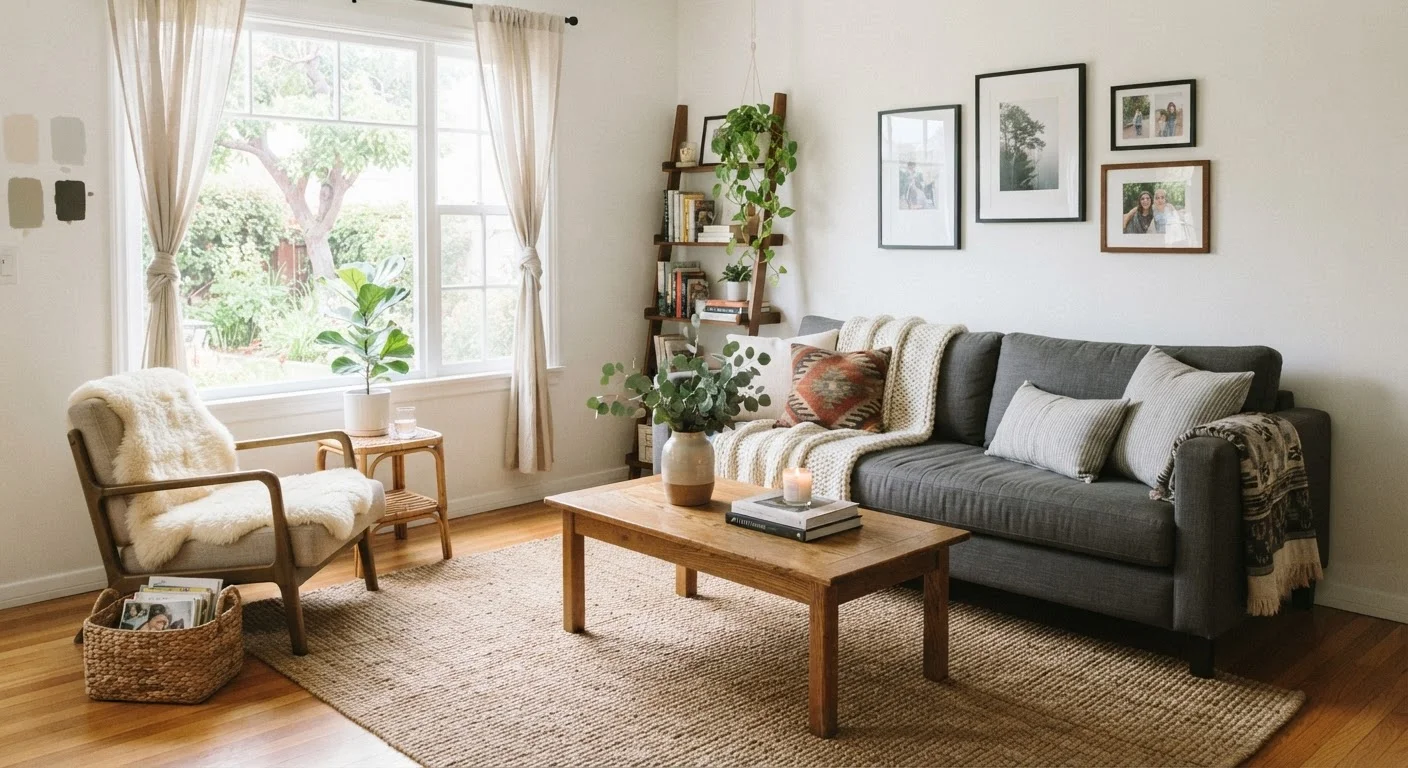
Our Verdict
The living room rewards selective spending. Putting real money into pieces that are touched, sat on, or walked across every day tends to pay off in comfort, durability, and long-term satisfaction. Saving on purely decorative or easily swapped elements keeps your budget flexible without sacrificing style. The goal isn't to spend as little as possible — it's to spend wisely where it counts.
| Best for | Recommended |
|---|---|
| Those refreshing a living room on a tight budget | Save broadly, splurge only on the sofa |
| Those planning to stay in their home long-term | Splurge on sofa, rug, and lighting; save on accessories |
| Those who redecorate frequently or follow trends | Save on most pieces; invest only in the largest anchor item |
| Those prioritizing daily comfort above aesthetics | Splurge on seating and lighting quality |
Why the Same Budget Logic Doesn't Apply to Every Item
A living room refresh rarely comes with an unlimited budget — and that's actually fine. The real challenge isn't how much you spend overall; it's deciding where to concentrate that spending. Spending equal amounts on every item is rarely the right approach, and neither is defaulting to the cheapest option across the board.
The most useful framework is deceptively simple: prioritize items by daily contact and lifespan. If something gets used constantly, absorbs physical wear, and would be expensive or disruptive to replace in a couple of years, it usually warrants a higher initial outlay. If something is purely visual, rarely touched, or easy to swap out when your taste changes, saving is almost always the smarter call. This is the same principle explored in evaluating price versus value — upfront cost is just one variable in the equation.
Where Spending More Tends to Pay Off
The sofa is the clearest case for spending more. It's the most-used piece of furniture in most homes — sat on daily, leaned against, occasionally slept on, and expected to look presentable for years. A low-cost sofa purchased to save money often pills, sags, or deteriorates within two to three years, meaning you pay for two sofas instead of one. Frame construction, cushion density, and fabric durability all matter in ways that aren't visible from a photo. As paying more upfront can lower total cost over time — the sofa is a textbook example of this principle in action.
The area rug is a close second. A rug anchors the entire room visually and takes significant foot traffic, pet activity, and regular vacuuming. Thin, inexpensive rugs tend to slip, shed, and compress quickly, losing both appearance and function. A well-constructed rug — even a mid-range one — will hold its shape and texture far longer.
Lighting is the most underrated place to invest. The quality and tone of light in a room has an outsized effect on how the space feels to live in — more than most decorative choices. Thoughtful layering (ambient, task, and accent lighting) changes a room's atmosphere in ways that no amount of throw pillows can replicate.
Test Before You Commit to Seating
When evaluating a sofa or chair, sit in it for several minutes — not just a few seconds. Check whether the cushions rebound, whether the seat depth is comfortable for your height, and whether the frame feels solid when you shift your weight. These physical tests reveal quality differences that product descriptions and photos rarely capture.
Where Saving Makes Genuine Sense
Decorative accessories — candles, vases, trays, small sculptures — are the easiest category to save on. These items carry low physical stress, are swapped out frequently as tastes evolve, and do not need to last a decade. Budget options here are often indistinguishable from expensive ones once placed in a room.
Throw pillows and blankets are both trend-sensitive and easy to replace. They're also items where personal preference changes quickly. Spending heavily on them locks you into a look you may tire of within a year or two.
Side and accent tables carry lighter loads and face less wear than primary seating. A simple, well-proportioned table from a budget-friendly source can function and look just as good as a costly alternative — particularly when paired with a higher-quality anchor piece nearby.
Wall art and framed prints are another area where price and quality diverge widely. The visual effect of thoughtfully chosen, inexpensive art is often equivalent to that of expensive pieces. What matters most here is composition, color, and placement — not the price tag. See how similar thinking applies to decorating with plants.
| Item | Splurge or Save? | Key Reason | |
|---|---|---|---|
| Sofa | Sofa | Splurge | Daily use; structural wear accelerates fast |
| Area Rug | Area Rug | Splurge | High foot traffic; visible degradation over time |
| Lighting | Lighting | Splurge | Dramatically affects room atmosphere and comfort |
| Throw Pillows | Throw Pillows | Save | Trend-sensitive; easily and cheaply replaced |
| Accent Tables | Accent Tables | Save | Light use; style impact comes from placement |
| Wall Art | Wall Art | Save | Visual effect depends on choice, not price |
| Decorative Accessories | Decorative Accessories | Save | Low wear; swapped out frequently |
Applying the Framework to Your Specific Situation
No framework works in isolation from your own circumstances. If you rent and move frequently, even the sofa calculus changes — portability and replacability become more relevant than longevity. If you have young children or pets, fabric choice and stain resistance matter more than thread count or weave complexity.
A useful habit before any purchase: ask how often you'll interact with this item, how visible wear will be, and how costly or disruptive replacement would be. Those three questions catch most poor spending decisions before they happen. These durable evaluation principles apply far beyond living rooms — they're worth building into any purchase decision.
It also helps to remember that a refresh doesn't have to happen all at once. Prioritizing the sofa or rug first — and filling in other pieces gradually — is a reasonable and often superior approach to buying everything at a lower quality simultaneously. For a broader look at which home upgrades genuinely change how a space feels to live in, see projects that improve liveability most.
7–10 years
Expected lifespan of a quality sofa
Interior design professionals generally cite this range for well-constructed sofas versus 2–4 years for lower-quality alternatives.
~30%
Portion of room budget often suggested for seating
Many interior decorators recommend allocating roughly a quarter to a third of a living room budget to the primary seating piece.
The content on this site is for informational purposes only and is not a substitute for professional advice. Always consult a qualified professional for guidance specific to your situation.