

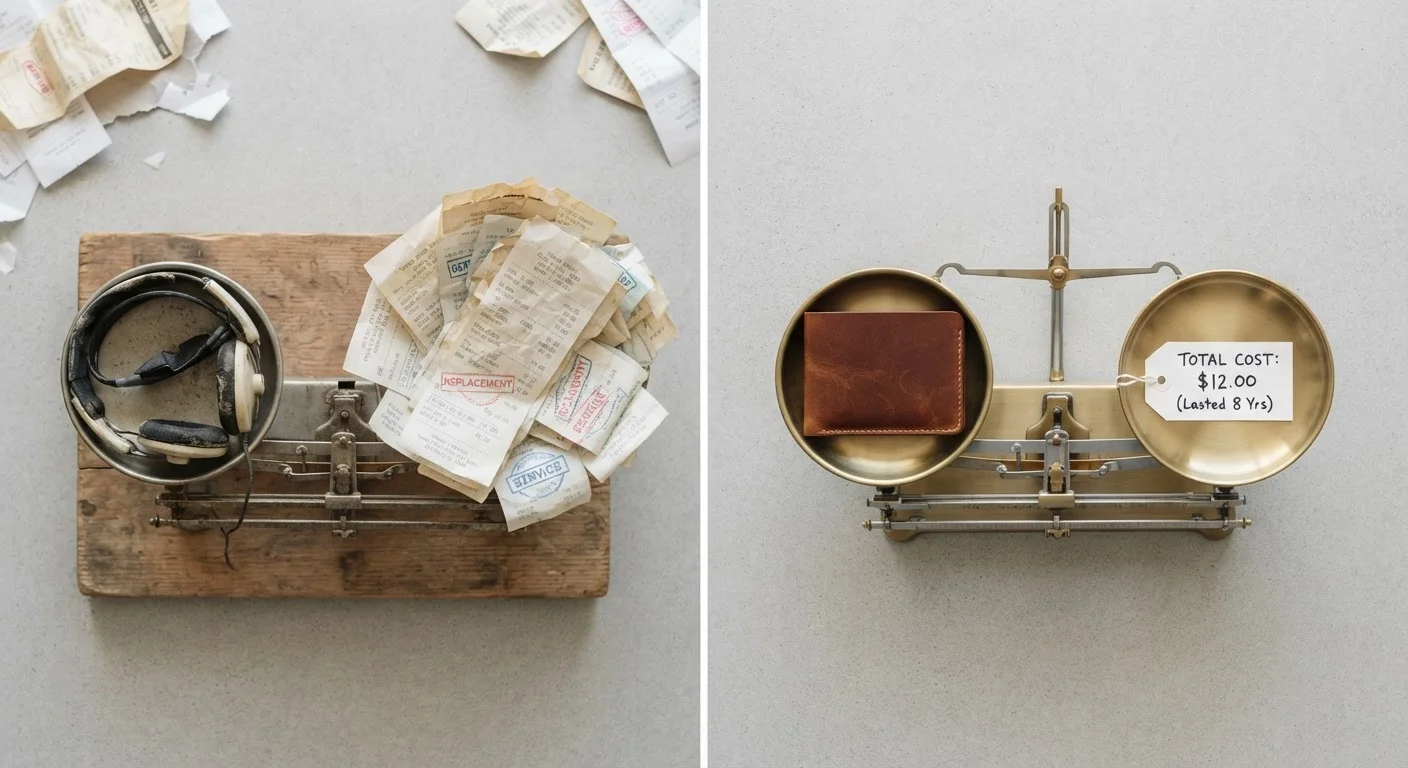
Why Sticker Price Is Only Part of the Story
Most people compare prices by looking at the number on the tag. That's understandable — it's the most visible figure. But for any purchase you'll live with for months or years, the tag price is often the least revealing number available.
What actually determines whether a purchase was worth it is how much you spend across the item's full lifespan. That's the logic behind total cost of ownership (TCO) — a concept that accounts for purchase price, operating costs, maintenance, and eventual replacement. When you factor all of that in, a $300 appliance and an $800 appliance can end up costing almost the same amount. Or the $800 model can cost considerably less.
This is why upfront cost is just one variable when evaluating a purchase. The full picture only comes into focus when you consider durability, running costs, and how long you'll actually keep the thing.
2–3×
Lifespan difference between quality tiers in common appliances
Consumer testing organizations consistently find significant lifespan variation between budget and mid-to-premium appliances in categories like washing machines and refrigerators.
$300–$500
Estimated annual energy savings from efficient appliances
The U.S. Department of Energy estimates that ENERGY STAR-certified appliances can save households hundreds of dollars annually compared to standard models, depending on usage patterns.
5–7 years
Typical break-even window for energy-efficient home upgrades
Analyses of insulation, windows, and appliance upgrades commonly show payback periods in the five-to-seven-year range, after which savings represent net financial gain.
The Three Drivers That Make Premium Prices Pay Off
Not all expensive products earn their premium. The ones that do tend to score better on at least one of three dimensions:
- Energy efficiency: Products that consume less electricity, fuel, or water can produce meaningful savings each month. Over several years, those savings accumulate into hundreds or thousands of dollars — potentially exceeding the original price gap.
- Durability: A product that lasts twice as long as a cheaper alternative effectively costs less per year of use, even if its upfront price is higher. This is especially true for items you use daily.
- Lower maintenance costs: Cheaper products in categories like tools, vehicles, and appliances can require more frequent repairs. If repair costs and inconvenience are factored in, the savings from going cheaper can evaporate quickly.
The calculation isn't always obvious. That's why it's worth looking at costs consumers routinely overlook — things like energy draw, consumables, and service fees that quietly inflate what you actually spend.
Run the Numbers Before You Commit
Before paying a premium, estimate your annual savings in energy, repairs, or replacements, then divide the price difference by that figure. If the break-even period is shorter than how long you expect to keep the item, the higher upfront cost is likely the better financial choice. If it's longer, the cheaper option may serve you just as well.
How to Find the Break-Even Point
Before paying a premium, it's worth doing a simple break-even calculation. The idea is straightforward: how long will you need to own this item before the annual savings offset the higher upfront cost?
Here's the basic formula:
Break-even (years) = Price difference ÷ Annual savings
For example, if a more efficient version of an appliance costs $200 more but saves $60 per year in energy costs, the break-even point is just over three years. If you expect to keep the appliance for eight years, the premium makes sense. If you're moving in six months, it likely doesn't.
Context matters just as much as the math. The timing of a purchase shapes its true value — including whether your current life circumstances make a long payback window realistic.
When Paying More Doesn't Actually Help
The logic of TCO has limits. Paying more doesn't always translate to long-term savings — and several situations make the premium genuinely not worth it:
- Low-frequency use: If you'll only use something occasionally, the durability benefit of a premium product matters far less. You won't wear it out anyway.
- Short time horizon: Renting a home, planning to move, or using something temporarily changes the math entirely. See what renters need to consider when making home-related purchases that may not travel with you.
- Rapidly evolving technology: In categories where products are replaced by innovation quickly, paying for longevity may not pay off if the product becomes obsolete before it wears out.
- Diminishing returns at the top tier: There's often a point where quality improvements become marginal but prices jump significantly. The middle tier of most product categories delivers most of the durability benefit without the luxury markup.
For a practical framework on where quality investment pays off versus where it doesn't, deciding where quality counts is a useful starting point even beyond home decor decisions.
Applying This Thinking to Financial Decisions
The same upfront-versus-long-term logic applies beyond physical products. Paying for better financial infrastructure — whether that's a higher-rate savings account, a qualified adviser, or a structured investment approach — can produce returns that far outweigh the cost of accessing it.
Understanding concepts like opportunity cost and sunk cost can also sharpen how you evaluate these trade-offs. Every dollar spent on something cheap that breaks in a year is a dollar that didn't compound into something else. And what compound interest actually does over time illustrates why the timing and structure of financial decisions matter just as much as the amounts involved.
The common thread: spending decisions are rarely just about the moment of purchase. The real question is always what a choice costs — and returns — across time.
This article is for general informational and educational purposes only. It does not constitute financial or investment advice. Consult a qualified financial professional for guidance tailored to your personal situation.
Frequently Asked Questions
Total cost of ownership is the sum of what you pay upfront plus all the costs you'll incur while using something — repairs, energy, consumables, and eventual replacement. For everyday shoppers, it's a useful mental framework for comparing two options that look very different at the register but may cost the same (or less) over time.
Estimate the annual savings in energy, maintenance, or replacement costs from the pricier option. Divide the price difference by those annual savings to find the break-even point in years. If you expect to keep the item longer than that, the premium is likely justified.
No. Quality premiums only pay off when you'll use the item long enough and frequently enough to recoup the upfront difference. For low-use or temporary items, a cheaper option may be the genuinely rational choice.
Appliances, vehicles, tools, mattresses, and building materials are categories where durability and running costs vary significantly by quality tier. Items you use daily or that have high energy or maintenance costs tend to reward upfront investment the most.
Yes. Reliable equipment reduces downtime, fewer breakdowns mean less stress, and durable items create less waste. These aren't strictly financial savings, but they represent real value that doesn't show up on a price tag.
The content on this site is for informational purposes only and is not a substitute for professional advice. Always consult a qualified professional for guidance specific to your situation.