

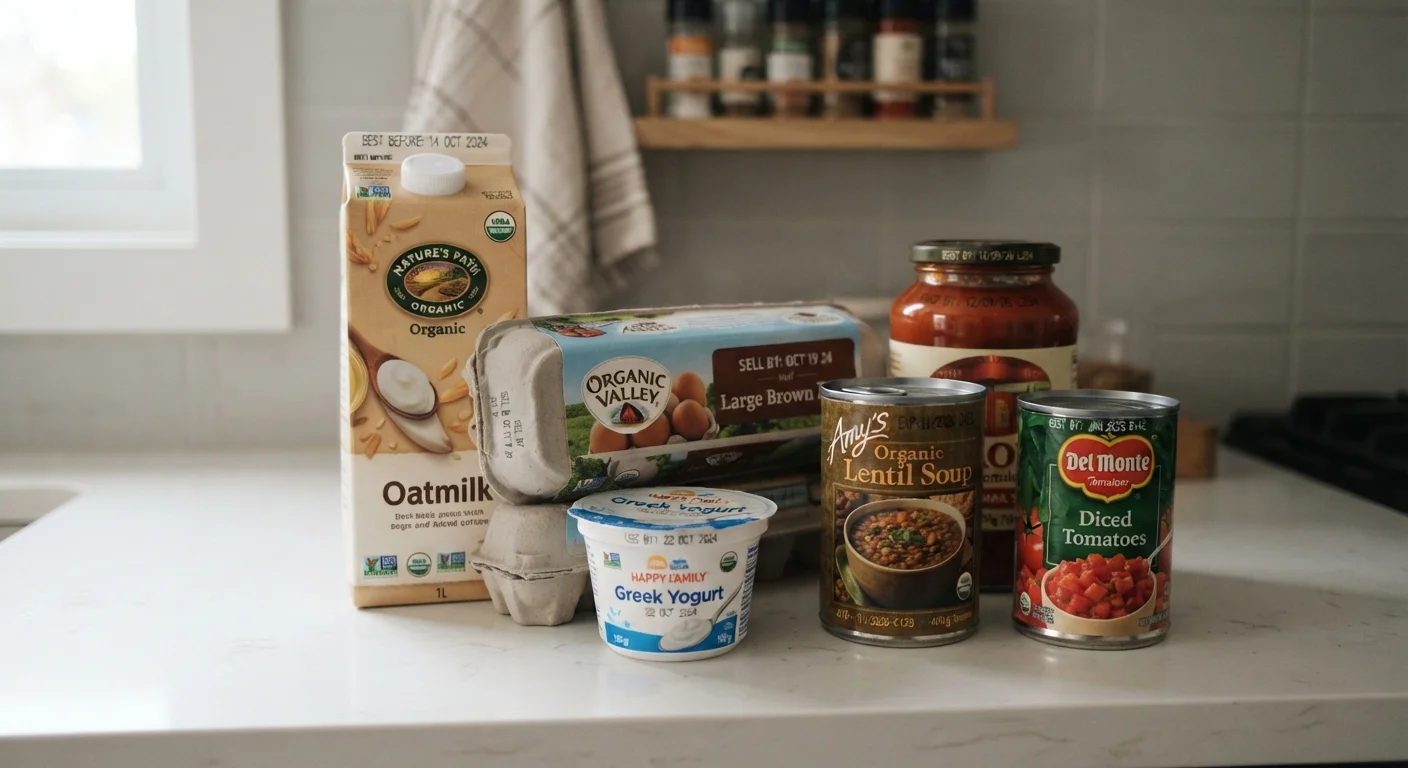
Why Three Labels, and Why It Matters
Grocery shoppers encounter date labels on nearly every packaged product, yet surveys consistently show that most people misread them. The result cuts two ways: food that is genuinely past its safe consumption window gets eaten, and food that is perfectly fine gets discarded prematurely. Both outcomes are worth avoiding.
The core confusion stems from the fact that these labels measure different things. One is about safety. One is about quality. One is about retailer logistics. Treating all three as the same warning is a common mistake — and one the food industry has historically done little to prevent.
80%
Consumers who discard food prematurely due to date label confusion
According to a Natural Resources Defense Council and Harvard Food Law and Policy Clinic report on food waste and date labeling.
20%
Reduction in household food waste possible through label standardization
Estimated by researchers studying the impact of clearer date labeling on consumer disposal behavior.
For a broader look at how food packaging communicates with consumers, see how to read a nutrition label — a practical companion to understanding what's printed on the package beyond just dates. And for a wider discussion of which product labels actually carry legal weight, reading a product label without getting lost in the fine print offers useful context.
What Each Label Actually Means
Best Before
A quality indicator showing when a product is at its peak flavor, texture, or nutritional value. Food past this date may still be safe to eat but could be diminished in quality.
Use By
A food safety date set by the manufacturer indicating the last date a perishable product should be consumed. Eating food past this date carries a genuine health risk.
Sell By
A inventory management date intended for retailers, not consumers. It tells stores how long to display a product on shelves but is not a reliable indicator of when it becomes unsafe.
Perishable
Foods that can spoil or become unsafe relatively quickly due to microbial growth, typically requiring refrigeration. Dairy, meat, and fresh produce are common examples.
Shelf-Stable
Foods that can be safely stored at room temperature for extended periods without spoiling. Canned goods, dried pasta, and crackers are typical shelf-stable products.
Best Before (or Best If Used By)
This label is about quality, not safety. Manufacturers use it to mark when a product is expected to be at its optimal flavor, texture, or nutritional potency. After this date, crackers may be stale, canned tomatoes may taste slightly flat, or a vitamin's potency may have declined — but none of these pose a food safety risk. For most shelf-stable products, "best before" dates can be treated as guidelines rather than hard cutoffs.
Use By
This is the label that warrants real attention. A "use by" date is a food safety indicator applied to perishable items — think raw meat, fresh fish, soft cheeses, and ready-to-eat refrigerated items. These are products where harmful bacterial growth is a realistic concern past the stated date. The USDA recommends following "use by" dates on perishable items strictly.
Sell By
"Sell by" is primarily inventory communication for retailers, not a consumer safety guide. It tells a store how long to keep a product displayed on shelves. Consumers typically still have usable time remaining on a product at the point of purchase — but how much depends on the product type and how it has been stored. Dairy bought on its sell-by date, for example, is often still good for several days when properly refrigerated.
Regulation Is More Limited Than You Might Expect
In the United States, federal law mandates date labels only on infant formula. All other food product date labels — including those on meat, dairy, and packaged goods — are largely set by manufacturers and are voluntary at the federal level. Some states have their own rules, but there is no single national standard governing their language or format. This means two packages using different wording can signal very different things, or sometimes the same thing.
Practical Guidance by Food Category
| Federally required date label | Only infant formula — all other food date labels are largely voluntary (U.S. FDA) |
| Estimated annual U.S. food waste | 30–40% of the food supply (USDA Economic Research Service) |
| Foods requiring 'Use By' attention | Raw meat, poultry, seafood, fresh dairy, ready-to-eat deli items |
| Eggs shelf life after purchase | 3–5 weeks refrigerated, regardless of carton date (USDA Food Safety and Inspection Service) |
| Standard industry initiative | Consumer Goods Forum's 2-label system: 'Use By' (safety) and 'Best If Used By' (quality) (Consumer Goods Forum, 2017) |
Not every product category carries the same risk. Here's a general framework consumers can apply:
- Raw meat and poultry: Follow the "use by" date closely. If frozen before that date, the product can be safely stored significantly longer.
- Dairy (milk, yogurt, hard cheese): Milk and yogurt may remain safe a few days past the sell-by date if consistently refrigerated. Hard cheeses have considerably more flexibility than soft varieties.
- Canned and dry goods: "Best before" dates on shelf-stable products like canned vegetables, dried pasta, or crackers are quality markers. These foods are generally safe well past their dates, though quality may decline.
- Deli and ready-to-eat items: Treat these more like the "use by" category — they're already prepared and can harbor pathogens if held too long.
- Eggs: The carton date is a quality indicator; refrigerated eggs are generally safe for several weeks after purchase. A simple float test in water can help assess freshness.
Food safety questions specific to your household situation — especially for immunocompromised individuals, pregnant people, young children, or older adults — are best discussed with a healthcare or food safety professional, as these groups face elevated risk from foodborne illness.
Understanding food labels is part of broader label literacy. The same critical eye applies to other categories: certifications and seals on consumer products deserve similar scrutiny, as does marketing language on personal care products.
This article provides general food labeling information for educational purposes. It is not a substitute for food safety guidance tailored to your specific health situation. Consult a qualified professional for personal dietary or health decisions.
The content on this site is for informational purposes only and is not a substitute for professional advice. Always consult a qualified professional for guidance specific to your situation.