

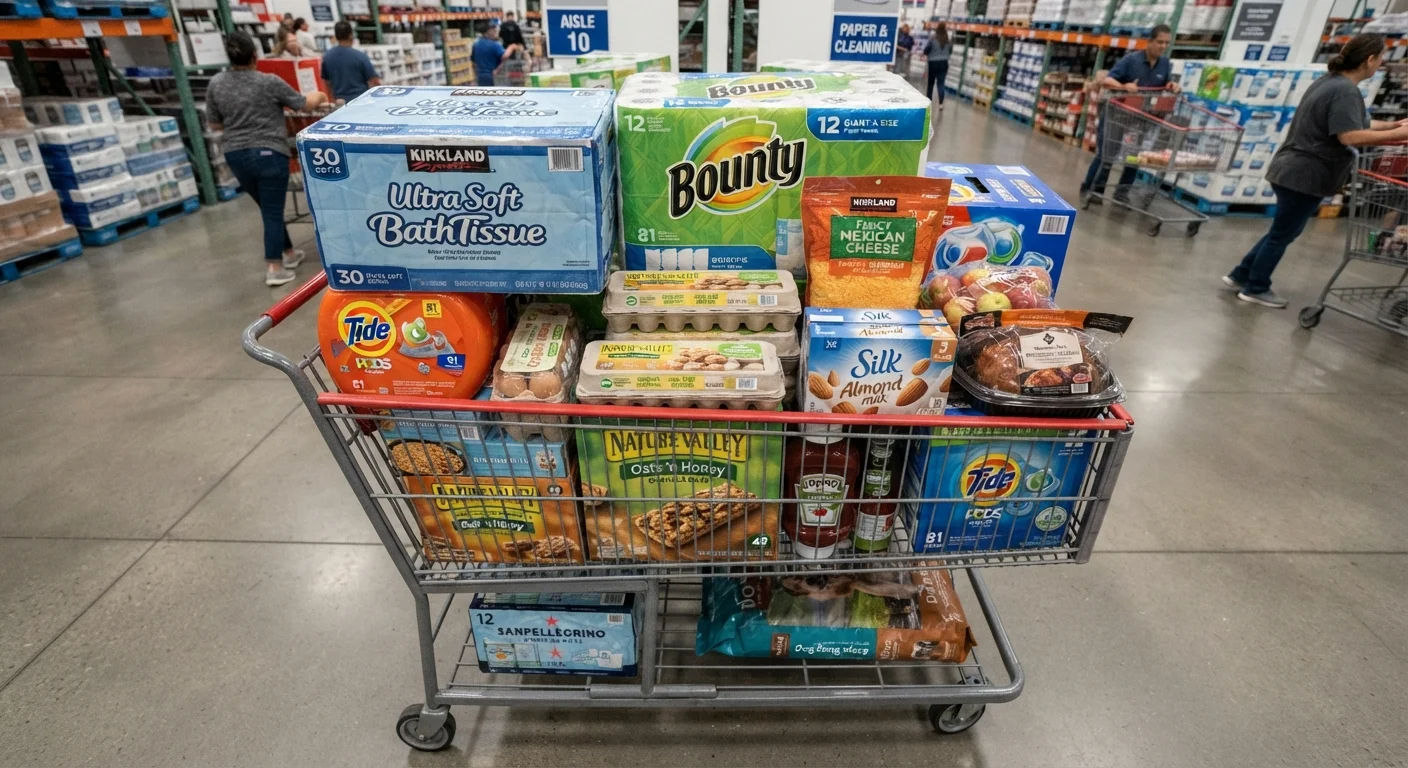
Our Verdict
Bulk buying genuinely reduces per-unit costs for the right categories — but it routinely costs more than expected when waste, storage, and tied-up cash are factored in. The strategy works well when consumption is steady, shelf life is long, and storage space isn't a constraint.
Households with consistent, predictable usage of non-perishable goods, ample storage, and the cash flow to absorb a larger upfront purchase without financial strain.
What Bulk Buying Actually Promises
The appeal of bulk purchasing is straightforward: buy more at once, pay less per unit. Warehouse clubs, online subscription programs, and large-format retail all market themselves on this premise. And the math, in isolation, is often real — the per-ounce price on a 96-roll case of paper towels typically is lower than the per-roll price at a convenience store.
But per-unit cost is only one variable in a more complicated equation. The total value of a bulk purchase depends on how much you actually use, how quickly you use it, how much space you have, and what you're giving up by spending that money upfront rather than gradually. Understanding those trade-offs is what separates a smart stock-up from an expensive overcommitment. See our guide to price versus value for a broader framework on evaluating what you actually pay.
Lower cost per unit on many staple goods
Buying in larger quantities consistently reduces the per-unit price on non-perishable staples, which adds up meaningfully for households that use those products at a steady rate.
Fewer shopping trips and less logistical friction
Stocking up reduces how often you need to repurchase routine items, which saves time and can reduce impulse purchases made during frequent smaller trips.
Buffer against short-term price increases
Buying ahead at a known price protects you from temporary price spikes — useful for goods affected by seasonal demand or supply disruptions.
Economies of scale work in predictable categories
For households with genuinely high consumption — large families, home-based businesses — the volume math often justifies the upfront outlay more reliably than for smaller households.
Where the Math Breaks Down
The most common way bulk buying fails consumers is through spoilage and expiration. A gallon of olive oil bought in bulk at a significant discount becomes a poor deal if two-thirds of it goes rancid before you use it. The same logic applies to cleaning products with active ingredients that degrade, medications with expiration dates, and even paper goods that can absorb moisture or become damaged in improper storage.
Beyond spoilage, there's the issue of liquidity. Spending $200 at once instead of $20 monthly ties up cash that might be needed elsewhere. For households managing tighter budgets, this trade-off is especially worth thinking through carefully. As our piece on hidden costs consumers overlook notes, membership fees for warehouse clubs can quietly reduce or eliminate savings if you're not purchasing enough volume to justify the annual cost.
Spoilage and waste can erase savings entirely
Any perishable or time-sensitive product that isn't fully used before it degrades turns a discount into a loss. This is especially common with food, certain cleaning products, and health items.
Large upfront cost reduces financial flexibility
Committing significant cash to inventory locks up money that might be needed for more pressing expenses, which is a real trade-off for households without large discretionary budgets.
Storage space and conditions are non-trivial requirements
Bulk goods need adequate, appropriate storage — temperature, humidity, and physical space all affect whether the quality holds. Not every household has that capacity.
Membership fees reduce net savings
Warehouse club memberships typically cost $50–$120 annually. Unless your purchasing volume is high enough to offset that fee, the effective savings per purchase shrink considerably.
Encourages over-consumption of some products
Research in consumer behavior suggests that larger quantities at home can increase usage rates for certain categories — particularly food — meaning the supply may not last as long as projected.
How to Evaluate Whether Bulk Makes Sense for You
The strongest candidates for bulk purchasing share a few consistent traits: long or indefinite shelf life, stable demand in your household, and no meaningful quality degradation over time. Dry goods like rice, dried beans, and pasta; household staples like laundry detergent and toilet paper; and consumables like batteries and trash bags typically meet this standard.
Before committing to a bulk purchase, it's worth asking three practical questions. First, will you realistically use the full quantity before it expires or degrades? Second, do you have adequate, appropriate storage — not just floor space, but conditions that preserve quality? Third, is the cash outlay comfortable given your current financial picture, or are you stretching for a savings that may not materialize?
Bulk Buying Isn't the Same for Every Household
A two-person apartment household and a six-person house have fundamentally different consumption rates, making the value calculation very different even for the same product. Evaluate bulk purchasing based on your actual usage patterns, not idealized estimates. When in doubt, track how quickly you actually use a product before buying it in quantity.
The logic of paying more upfront to spend less overall is related but distinct — bulk buying is about volume, not quality tier. Both decisions benefit from the same discipline: running the actual numbers rather than assuming savings.
~$65B
Annual US warehouse club retail sales
Warehouse club formats represent a substantial share of US consumer spending, reflecting widespread appeal of the bulk model — though individual savings vary considerably by household.
30–40%
Estimated US household food waste rate
According to USDA estimates, US households waste roughly 30–40% of the food supply, a figure that underscores how quickly over-purchasing can negate per-unit savings.
The content on this site is for informational purposes only and is not a substitute for professional advice. Always consult a qualified professional for guidance specific to your situation.