

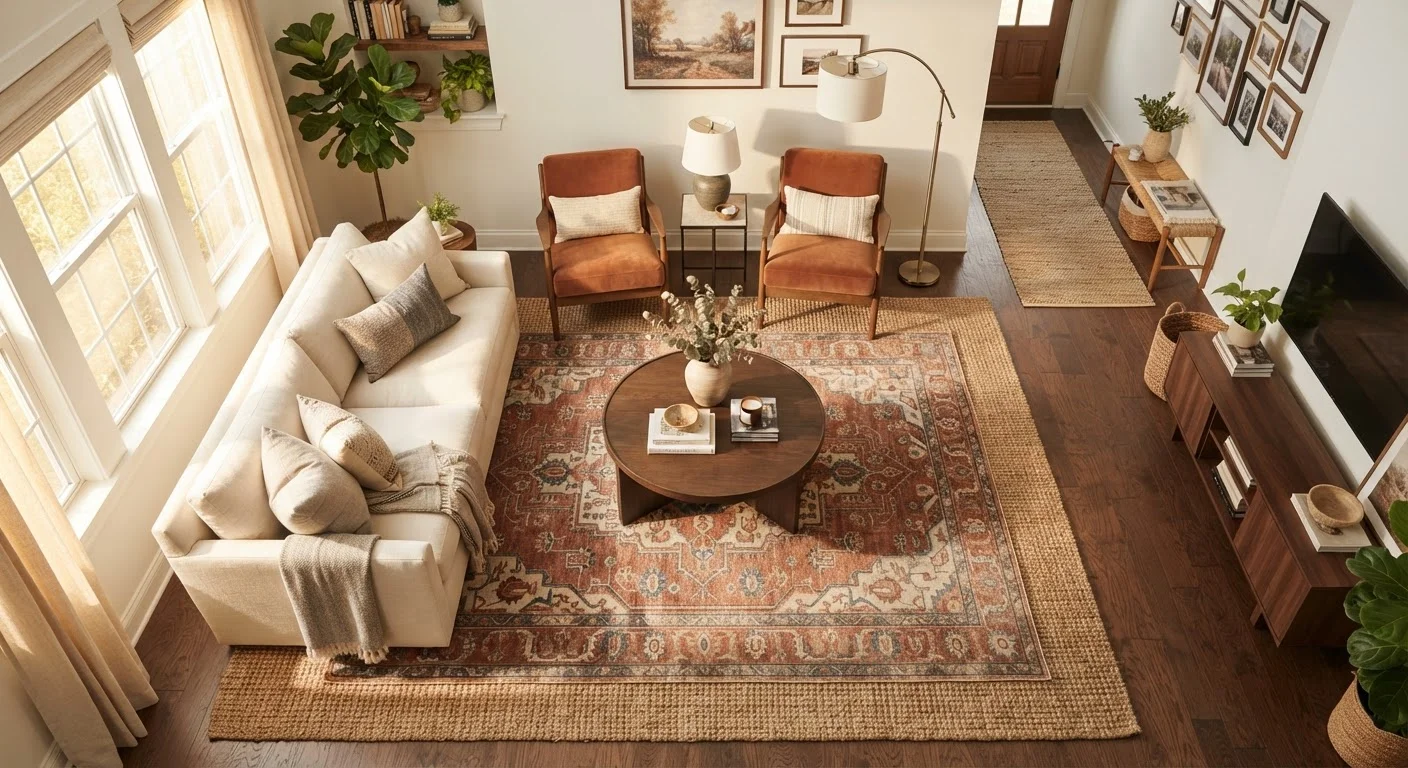
Why Rug Size Is the Most Misunderstood Décor Decision
Walk into almost any home and you'll spot the same mistake: a rug that's too small, floating like an island in the center of the room while the furniture sits around it on bare floor. It's one of the most common — and most fixable — décor errors.
A correctly sized rug does something no piece of furniture can do on its own: it defines the zone. It signals where a conversation area ends, where the dining table lives, and how much visual weight a room should carry. Get the size wrong and the whole space feels unsettled, no matter how nice the furniture is.
If you're building a room from scratch, rug sizing is one of the first decisions to lock in. See our step-by-step guide for first-timers for how rug choice fits into a broader room-building sequence.
| Minimum living room rug size | 8×10 ft for standard seating arrangements |
| Dining room rug extension rule | 24 inches beyond each side of the table |
| Bedroom rug clearance | 18–24 inches on sides and foot of bed |
| Wall-to-rug gap (average rooms) | 12–18 inches on each side |
| Best base rug material for layering | Flat-weave natural fiber (jute, sisal, flatwoven wool) |
| Most common rug sizing mistake | Choosing a rug too small for the furniture grouping |
Sizing Rules by Room Type
There is no universal rug size — the right dimensions depend on the room's function and the furniture arrangement within it.
Living Rooms
The most reliable rule: all four legs of the main seating pieces should sit on the rug, or at minimum the two front legs of each piece should touch it. A rug that only fits the coffee table is almost always too small. For a standard sofa-plus-two-chairs arrangement, an 8×10 ft rug is typically the starting point; 9×12 ft is often more appropriate in open-plan spaces.
Dining Rooms
The rug must extend at least 24 inches beyond the edge of the table on all sides — enough that chairs remain on the rug even when pulled out. Measure your table, add 48 inches to each dimension, and use that as your minimum rug size. Skimping here creates a scraping problem every time someone sits down.
Bedrooms
Two approaches work well. A large rug (8×10 ft or bigger for a queen/king bed) should extend 18–24 inches on the sides and foot of the bed. Alternatively, runners placed on each side of the bed give a softer landing without requiring a single oversized piece. Avoid placing a small rug only at the foot — it reads as an afterthought.
For rooms where every square foot counts, sizing decisions intersect with layout strategy. The principles in our article on small-space design apply directly to rug placement in compact rooms.
Area rug
A rug that covers a defined portion of a floor, used to anchor a furniture grouping or designate a functional zone within a room.
Zone definition
The visual and spatial separation of functional areas within an open or multi-use room, often achieved with rugs, furniture arrangement, or lighting.
Flat-weave rug
A rug with no pile — woven so both sides are flat. It lies very close to the floor, making it ideal as a base layer in a layered rug arrangement.
Rug layering
The practice of placing one smaller, often more decorative rug on top of a larger, plainer base rug to add texture, pattern, and visual depth to a space.
Natural fiber rug
A rug made from plant-based materials such as jute, sisal, seagrass, or hemp. These tend to have a flat or low profile and earthy texture, often used as neutral base layers.
Placement Logic: How to Position a Rug Correctly
Once you have the right size, placement determines whether the rug anchors the room or fights it.
- Center the rug under the focal point, not the room's geometric center. In a living room, that focal point is usually the sofa wall or fireplace. In a dining room, it's the table.
- Leave equal breathing room between the rug edge and the walls — typically 12–18 inches in average-sized rooms, more in large rooms. Asymmetric gaps on opposite walls create visual tension.
- Align the rug's orientation with the room's longer axis. A horizontally placed rug in a narrow room can make the space feel even more pinched.
Rug placement and furniture layout are deeply connected. Before repositioning either, use the room-layout checklist to anticipate traffic flow and focal-point issues first.
Test with Painter's Tape Before You Buy
Before purchasing a rug, use painter's tape to mark the rug's dimensions on your floor. Live with the taped outline for a day — walk around it, sit in your usual spots, observe it in different lighting. This simple step prevents expensive returns and makes sizing decisions much easier to visualize.
Layering Rugs: When It Works and When It Doesn't
Layering — placing a smaller, more decorative rug on top of a larger neutral base rug — has become a widely used technique. Done well, it adds depth, warmth, and visual interest. Done poorly, it looks cluttered and creates a tripping hazard.
When Layering Works
- The base rug is a flat-weave or low-pile natural fiber (jute, sisal, or flatwoven wool) that stays flat and grips the floor.
- The top rug is smaller, centered, and has a clear visual relationship to the base — either complementary texture or a contrasting pattern that reads intentional.
- The base rug is large enough to define the zone independently; the top rug adds personality, not structure.
When to Skip It
- Both rugs are thick-pile — this creates instability and a bunched appearance.
- The two patterns compete without a unifying color or scale relationship.
- The room is already visually busy with pattern on upholstery or curtains.
Layering is fundamentally a texture play. For a deeper look at how varied textures interact across a whole room, see our guide on textures that do the work.
One myth worth dispelling: layering isn't a fix for a rug that's too small. A small rug layered on another small rug still doesn't define the room. Proportion has to come first. The interior decorating myths article covers this and similar assumptions worth rethinking.
2 ft
Minimum chair clearance beyond dining table edge
Interior design guidelines consistently cite 24 inches as the minimum rug extension needed so dining chairs remain on the rug when pulled out.
8×10 ft
Most commonly recommended living room rug size
Home furnishing guides widely cite 8×10 ft as the starting point for a standard three-piece living room seating arrangement.
The content on this site is for informational purposes only and is not a substitute for professional advice. Always consult a qualified professional for guidance specific to your situation.