

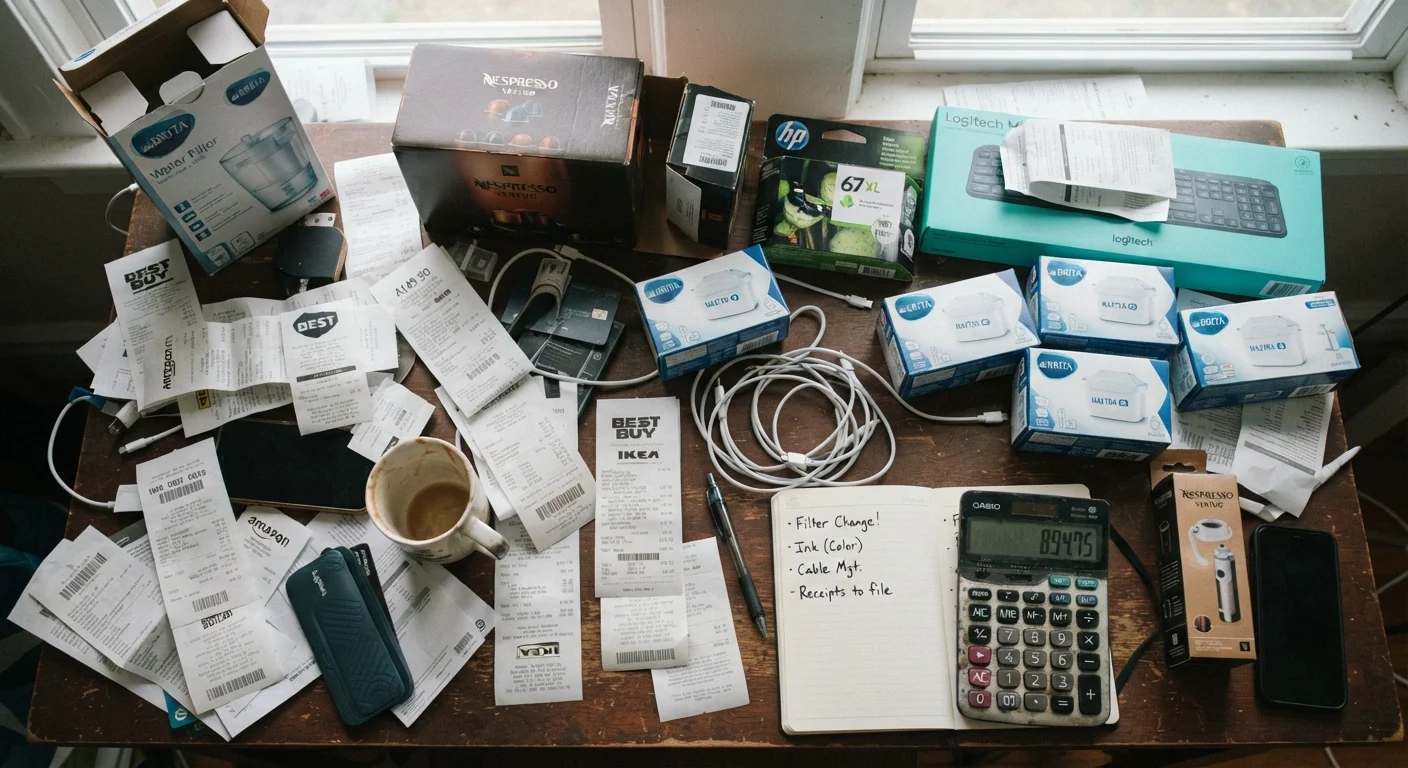
Why the Purchase Price Is Rarely the Whole Story
A price tag answers one question: what does this cost to acquire? It rarely answers the more important question: what will this cost to own? Installation charges, proprietary consumables, mandatory subscriptions, and routine upkeep are almost never factored into the number on the shelf — yet they routinely exceed the upfront cost over a product's lifetime.
Understanding these layers before you commit is the difference between a good value and an expensive regret. Our framework for comparing lifetime cost to purchase price offers a structured way to run those numbers. This article focuses on the specific mistakes that cause those costs to go unexamined in the first place.
Ignoring installation and setup fees when comparing prices across retailers.
Why it happens: Retailers advertise the product price, not the total delivered-and-working price. Buyers assume setup is straightforward or included until they're presented with a separate invoice.
Underestimating the annual cost of proprietary consumables like ink, filters, and pods.
Why it happens: The upfront price is low and attention goes there. The recurring consumable cost is buried in spec sheets or only discovered when the first replacement is needed.
Buying a product without realizing core features require a paid subscription to access.
Why it happens: Marketing emphasizes hardware capabilities; subscription requirements are disclosed in fine print or only during device setup, after the return window has often closed.
Overlooking compatibility costs that require upgrading adjacent equipment.
Why it happens: Each product is evaluated in isolation. The cascading requirements — a faster router, a compatible battery platform, a higher-rated circuit — only become visible during setup.
Forgetting routine maintenance costs when calculating whether a product fits the budget.
Why it happens: Maintenance feels distant at the point of purchase. Buyers focus on the immediate transaction and mentally defer ongoing upkeep costs.
The Costs That Catch Buyers Off Guard
Post-purchase expenses cluster into predictable categories. Knowing which ones apply to your product type lets you ask better questions before you buy.
2–4×
Lifetime consumable cost vs. printer purchase price
Consumer advocacy analyses have repeatedly found that ink and toner costs over a printer's life commonly exceed the hardware cost by two to four times, depending on usage patterns.
$273
Average annual US household spend on subscriptions
C+R Research survey data indicates US consumers routinely underestimate their monthly subscription total, often by a significant margin, with the gap widest for services tied to hardware purchases.
Installation and delivery are the first ambush. Large appliances, fitness equipment, and furniture frequently carry separate delivery, assembly, or haul-away fees. A refrigerator may require a water-line hookup billed separately. An air conditioner may need professional installation to preserve a warranty.
Proprietary consumables are a longer-term trap. Printers, coffee machines, water filtration systems, and air purifiers are often priced low upfront precisely because the manufacturer profits on replacement cartridges, pods, or filters. Calculate the annual consumable cost before treating the sticker price as the reference point. For a deeper look at how small recurring charges accumulate, see how spending leaks quietly drain a budget.
Software and feature unlocks increasingly affect hardware. Smart devices, cameras, and even some appliances now gate useful functionality behind ongoing subscriptions. A security camera may record locally for free but require a monthly plan for cloud storage or advanced detection. Understanding what subscription agreements actually commit you to helps avoid being locked in after the fact.
Watch for 'Free Trial' Hardware Bundles
Some devices are sold with a free trial of a companion service already activated. When the trial ends, the device's functionality may be significantly reduced unless you subscribe. Check the trial duration and post-trial feature set before considering the purchase complete.
Compatibility costs surface when a new purchase requires upgrading surrounding equipment — a new gaming console that needs a faster TV, or a power tool that uses a proprietary battery platform incompatible with tools already on the shelf. These costs are easy to miss because they don't appear on the product's own spec sheet.
For vehicle buyers, the same logic applies. The sticker price doesn't reveal dealer fees, add-ons, or ongoing ownership costs, and total cost of ownership for a vehicle encompasses fuel, insurance, and maintenance well beyond the purchase transaction. Similar dynamics apply to housing — renters and buyers alike encounter costs that don't appear in the headline number.
The solution isn't to avoid purchases — it's to ask a consistent set of questions: What does this need to function? What wears out and how often? Are any useful features paywalled? Hidden costs routinely overlooked by consumers extend across shipping surcharges, activation fees, and auto-renewals — the same discipline applies everywhere.
The Return Window Closes Before Costs Emerge
Most hidden costs — subscription requirements, consumable expenses, compatibility gaps — only become clear during the first weeks of ownership. Standard return windows are often 15 to 30 days, meaning you may discover a problem just as your recourse disappears. Research post-purchase costs before buying, not after. Features that rarely get used often come bundled with costs that persist even when the feature is ignored.
The content on this site is for informational purposes only and is not a substitute for professional advice. Always consult a qualified professional for guidance specific to your situation.