

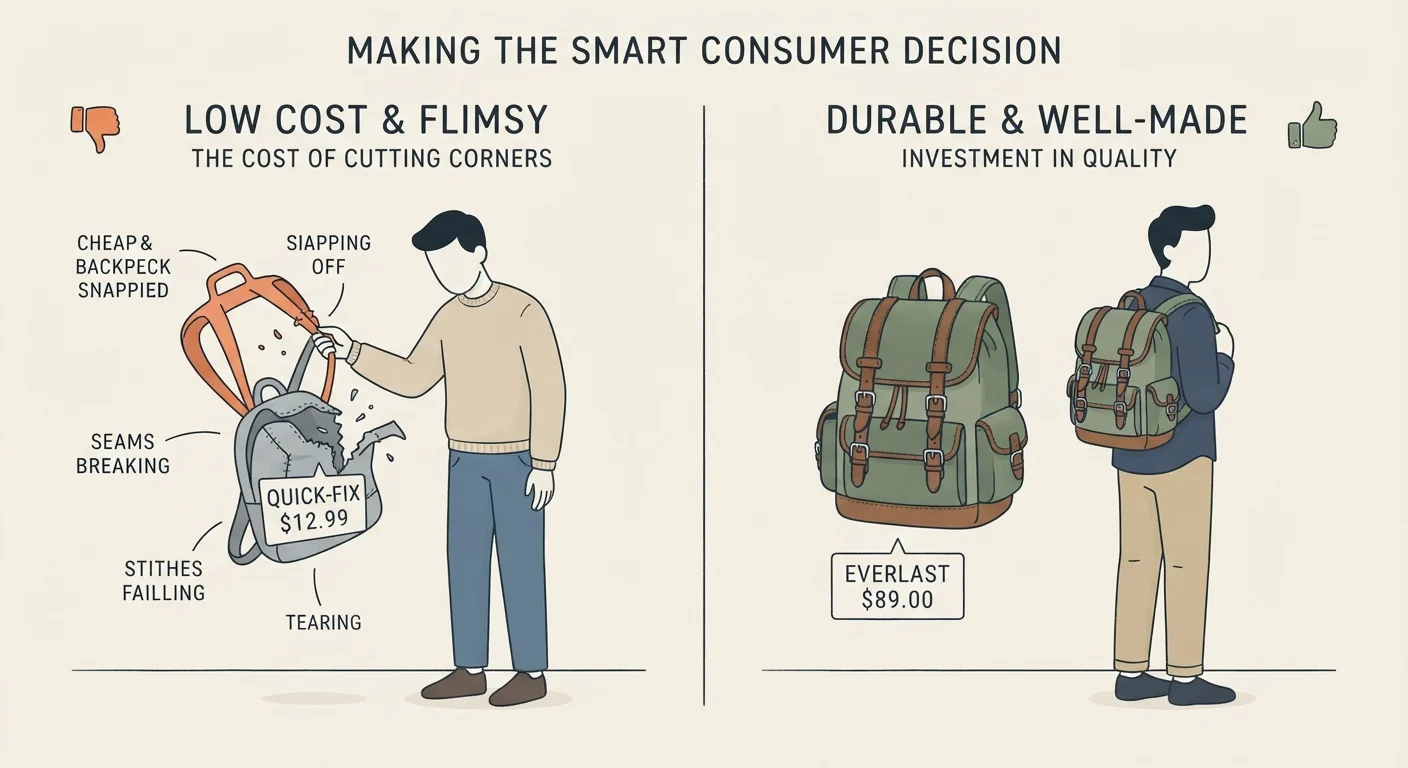
The Myth of the Smart Cheap Buy
Frugality is a virtue — until it quietly costs you more. Choosing the lowest-priced option feels like responsible money management, and sometimes it is. But the assumption that cheapest automatically equals smartest is one of the most persistent myths in consumer spending.
Price is easy to compare. Value is harder. What you pay at checkout is only one variable; what the purchase actually costs you over time — in replacements, repairs, wasted time, or missed performance — is the fuller picture. Understanding that difference is the foundation of genuinely informed spending. See how price and value diverge across real purchasing scenarios.
Myth
If something is cheaper, you're automatically saving money.
Fact
Lower price at purchase doesn't mean lower total cost — replacement frequency, ongoing fees, and performance gaps all affect what you actually spend.
Saving money requires comparing total expenditure over a realistic ownership period, not just the checkout amount. A cheaper item that fails sooner, requires expensive accessories, or underperforms so much that you supplement it with another purchase can easily cost more than a higher-priced alternative that doesn't. True savings show up in the full accounting, not the receipt.
Myth
Paying more always means better quality.
Fact
Price and quality correlate inconsistently across product categories — some premiums reflect genuine performance differences, others reflect brand marketing alone.
Research consistently shows that in certain categories — basic commodities, many generic pharmaceuticals, standard household supplies — the performance gap between cheap and expensive options is negligible. In others, durability and materials genuinely differ. The skill is knowing which category you're shopping in, not assuming that a higher price always buys you something meaningfully better.
Myth
Buying cheap is always the responsible financial choice.
Fact
Optimizing for the lowest price on every purchase can actually reflect poor financial planning when it ignores lifecycle costs and replacement frequency.
Responsible spending means evaluating value across time, not minimizing each individual transaction. Buying a low-cost item that requires frequent replacement or fails quickly can tie up more money and time than a considered investment in a durable option. Frugality applied without that context can quietly work against the goal it's supposed to serve.
Myth
The sticker price is the full cost of what you're buying.
Fact
Many purchases carry significant costs that appear only after the sale — shipping, installation, consumables, warranties, and subscriptions among them.
The post-purchase cost landscape is where many cheap options reveal their real price. Proprietary ink cartridges, replacement filters, subscription-only features, activation fees, and mandatory accessories can transform an apparently low-cost product into a high-cost one within months. Comparing sticker prices without accounting for these downstream costs produces an incomplete and often misleading picture. See also: costs consumers routinely overlook.
Myth
If a product is heavily discounted, it must be a good deal.
Fact
Discounts are calculated from a reference price that may itself be inflated, and deeply discounted goods are sometimes counterfeit, grey-market, or discontinued for a reason.
A 50% discount on a product with an artificially inflated original price may represent no savings at all. Meanwhile, prices that seem implausibly low — especially from unfamiliar sellers — sometimes signal counterfeit or grey-market goods that lack manufacturer support, safety certification, or quality control. Evaluating a deal means understanding what the realistic market price is, not just the size of the markdown.
Where Cheap Choices Quietly Add Up
The clearest cases where low upfront cost backfires tend to involve frequency of use and replacement cycles. A low-cost item that wears out in months and gets replaced twice costs more annually than a mid-range item bought once. This arithmetic is obvious in hindsight but easy to miss at the point of purchase.
2–3x
Replacement frequency for lowest-tier products
Consumer research on durable goods commonly finds that the cheapest tier of products is replaced two to three times more often than mid-range alternatives in the same category.
~30%
Of product cost hidden in post-purchase fees
Studies on total cost of ownership in electronics and appliances suggest that recurring costs — consumables, subscriptions, maintenance — can represent 20–35% of total lifetime spend beyond the purchase price.
Beyond direct replacement costs, consider what economists call opportunity cost — the value of what you give up. Time spent returning defective items, troubleshooting poor-quality products, or shopping again for a replacement is a real cost, even if it doesn't show up on a receipt. Sunk cost and opportunity cost are two concepts that quietly shape the true price of every spending decision.
Fees and add-ons compound the issue. A cheap product may require expensive proprietary accessories, consumables, or subscription upgrades that a slightly pricier alternative bundles in. These are easy to miss at the research stage. Hidden post-purchase costs — installation, consumables, and ongoing upkeep — rarely appear in the sticker price.
Watch for Suspiciously Low Prices
Prices significantly below the market norm for identical goods can indicate counterfeit products, grey-market imports without warranty coverage, or items discontinued due to safety or quality issues. Before assuming a low price is simply a good deal, verify the seller's authorization status and check whether the product carries standard safety certifications for its category.
When Cheap Is Genuinely the Right Call
None of this means premium always wins. Plenty of purchasing decisions don't justify spending more. Low-frequency use items, products where generic and name-brand versions are functionally identical, and categories with minimal performance variation are legitimate cases for choosing the cheapest option available.
Generic versions of many household staples, over-the-counter medications, and basic tools often meet the same standards as their pricier counterparts. Brand premiums are sometimes justified and sometimes pure marketing — knowing which category a product falls into is the real skill.
The question isn't whether cheap is bad. It's whether the cheapest option delivers adequate value for your specific use case. A $10 item used twice and discarded may be exactly right. The same $10 item used daily and replaced every month is a poor deal.
Use Frequency Changes Everything
The most important factor in evaluating whether cheap is smart is how often you'll use the item. For daily-use products, durability and running costs matter far more than purchase price. For occasional or one-time use, a low upfront cost is often exactly the right choice. Always match your spending calculus to your actual use pattern — not a hypothetical one.
A More Useful Framework for Spending Decisions
Rather than anchoring on sticker price, three lenses tend to give a clearer picture: unit price (cost per measurable unit), total price (full purchase price), and value per use (cost divided by expected number of uses). These three measures combined reveal what you're actually getting for your money far better than sticker price alone.
For higher-stakes purchases — appliances, vehicles, tools — it's also worth examining whether a higher upfront investment genuinely lowers your total cost over time. Paying more upfront can reduce total spend, but only under specific conditions: long ownership periods, meaningful quality differences, and lower running costs. Without those factors, the premium may not be justified.
Finally, watch for artificially low prices that signal grey-market or counterfeit goods. A price that seems implausibly low often is. Understanding the difference between genuine discounts and grey-market goods protects both your wallet and your safety.
The content on this site is for informational purposes only and is not a substitute for professional advice. Always consult a qualified professional for guidance specific to your situation.