

Our Verdict
Maximalist decorating can produce some of the most distinctive, enveloping interiors imaginable — but it requires real skill to execute without tipping into visual chaos. The style rewards those who have a clear personal aesthetic, enjoy ongoing curation, and aren't planning to sell soon. For everyone else, selective maximalism — bold choices in one or two rooms — offers most of the joy with far fewer complications.
Best suited to confident, style-driven decorators who own their home, have strong editing instincts, and want a space that feels unmistakably personal.
What Maximalism Actually Means
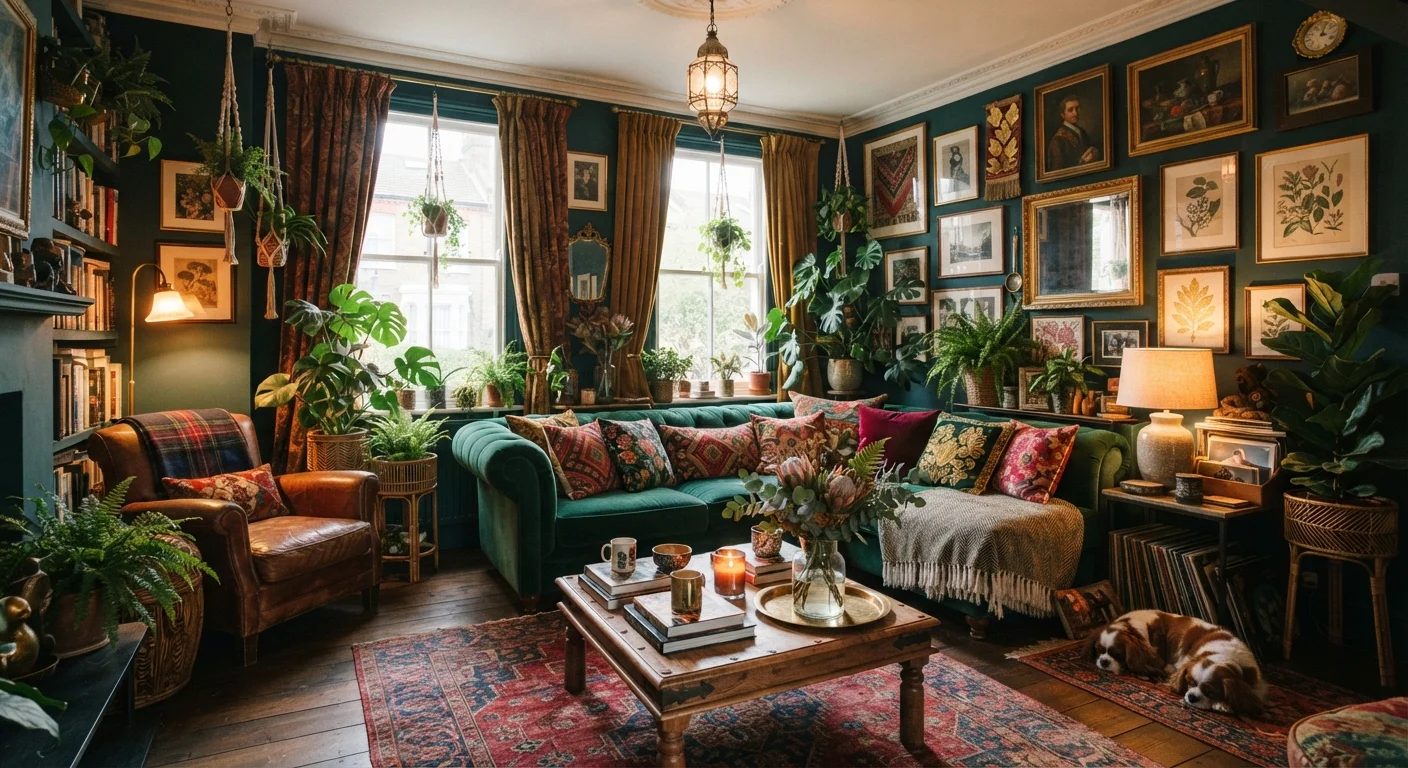
Maximalism is often misread as simply owning a lot of things. In practice, it's a deliberate design approach built on layering — colour on colour, pattern on pattern, texture on texture — to create rooms that feel full, expressive, and intentional. Where minimalism edits down to essentials, maximalism argues that abundance itself is the aesthetic.
The distinction matters because it sets the bar for execution. A maximalist room that works is carefully composed: every object earns its place, collections are internally coherent, and contrast is managed so the eye has somewhere to rest. A room that's merely crowded is just crowded. Understanding that gap is the starting point for anyone considering this style honestly.
Maximalism Is Not the Opposite of Good Taste
A common misconception is that maximalism rejects the rules that make minimalism work — balance, proportion, and a coherent palette. In fact, those principles become more important, not less, when you're working with more elements. Several widely-held decorating rules — like "everything must match" — actually constrain maximalist spaces more than help them. Understanding which rules to keep and which to discard is central to the style.
The Real Advantages of Going Maximalist
The case for maximalism is genuinely compelling, and it goes beyond aesthetics.
Creates deeply personal, emotionally resonant spaces
Maximalist rooms reflect accumulated taste, travel, and history in ways that feel genuinely inhabited. Guests tend to find them memorable and warm rather than sparse or generic.
Accommodates imperfect budgets and mixed sources
The style actively welcomes pieces from different eras, price points, and origins. A carefully chosen mix of vintage, inherited, and new items can work together without looking mismatched.
Tells a visual story no algorithm can replicate
When collections are curated with intention, a maximalist room communicates something specific about its inhabitant — a quality that mass-produced interiors rarely achieve.
Absorbs new acquisitions without looking mismatched
Because abundance is the point, adding a new piece doesn't destabilise the room the way it might in a minimal scheme where each object carries more visual weight.
Pattern and colour layering can disguise wear and imperfections
Busy surfaces and layered textiles are forgiving of scuffs, stains, and imperfect walls — a practical advantage in older homes or high-traffic family spaces.
One under-appreciated benefit is flexibility. Because maximalism embraces mixing eras, materials, and origins, it's forgiving of imperfect budgeting. A vintage find, an heirloom piece, and a modestly priced accent can coexist — you don't need a curated matching set to make it work. For a framework on where to put your money in a living space, see where quality counts and where it doesn't.
The Honest Disadvantages
The challenges of maximalism are real, and they deserve equal attention before you commit significant time and money.
Difficult to execute without strong editing instincts
The line between intentional layering and visual noise is narrow. Without a clear internal logic — colour palette, thematic thread, or stylistic era — maximalist rooms quickly feel overwhelming rather than expressive.
Significantly higher ongoing maintenance demands
More objects, surfaces, and textiles mean more dusting, straightening, and seasonal rotation. The upkeep commitment is real and compounds over time.
Can complicate resale or staging for buyers
Highly personalised interiors often polarise prospective buyers. Sellers frequently need to repaint, de-clutter, and restage before listing, which adds cost and effort.
Expensive to get right — and easy to waste money on
Maximalism can consume budget quickly. Without a guiding vision, impulse purchases accumulate into clutter rather than cohesion, and many pieces end up being replaced.
Challenging in small or poorly lit spaces
Heavy pattern and dense layering can make compact rooms feel claustrophobic. Low-light conditions amplify this effect, making careful consideration of scale and placement essential.
Difficult to photograph for rental listings or home sales
Maximalist interiors often require significant styling or de-staging to photograph well, which matters if you ever need to list the space for rent or sale.
Visual clutter is the most common failure mode, and it happens faster than most people anticipate. If you've ever struggled with a gallery wall tipping from curated to chaotic, the common missteps that make gallery walls feel overwhelming offer a useful preview of how quickly maximalism can go wrong at smaller scale.
Open storage compounds the challenge. Maximalist rooms frequently feature displayed collections and open shelving — elements that look effortless in design photography but require consistent upkeep. What open shelving actually demands day-to-day is worth understanding before committing to a style that tends to feature it heavily.
Practical Considerations Before You Start
A few structural questions are worth working through before investing in a maximalist direction.
Do you rent or own?
Renters face genuine limitations. Bold wallpaper, built-in shelving, and heavily anchored gallery arrangements all carry deposit risk. That doesn't make maximalism impossible in a rental, but it does require a damage-free approach. Reversible techniques for personalising a rental can help you get much of the effect without the financial exposure.
How do you feel about maintenance?
Layered interiors collect dust in proportion to their complexity. More surfaces, more textiles, more objects means a materially longer cleaning routine. If your tolerance for upkeep is low, the style will gradually feel like a burden rather than a pleasure.
Are you planning to sell?
Heavily personalised interiors can be polarising for buyers. Most real estate professionals suggest a more neutral presentation for sale — which means a maximalist home may require significant re-staging or repainting before listing. Budget for that reality if it's relevant to your timeline.
68%
Homeowners who redecorate within 2 years of a major style change
According to Houzz's annual renovation research, a significant share of homeowners revisit bold decorating decisions relatively quickly, suggesting that full commitment to a dramatic style carries revision risk.
3–5x
Longer cleaning time in maximalist vs. minimal rooms
Interior design professionals commonly estimate that layered, object-dense rooms require substantially more routine maintenance than pared-back spaces, though exact figures vary by room size and density.
Consider a room-by-room approach
Rather than committing to maximalism throughout, many decorators find that applying it to a single room — a home library, a bedroom, a dining room — delivers most of the emotional payoff while keeping the rest of the home liveable and adaptable. It also lets you test your own editing instincts before scaling up. For more on the principles that govern how space actually functions, spatial and design principles for compact homes apply even when the goal is abundance rather than minimalism.
The content on this site is for informational purposes only and is not a substitute for professional advice. Always consult a qualified professional for guidance specific to your situation.